CHORDS
This chapter will derive the blade chords needed for a given thrust ( or induction ).
A helpful dimensional idea can be obtained by looking at the case of small pitch angles.
A ring of the prop disk is "served" by the area of the blade elements in the ring. The thrust on these blade elements must provide the induction in the whole of the ring. From figure 8.2 , the circumferential airspeed of the blade at small pitch angles is W ≅ Ω.r. The lift of the blade elements is proportional to ½ ρ W 2, and therefore the blade lift is proportional to r 2.
The blade elements at that radius cover a ring of area 2πr. Comparing the two, the chord needed for a given induction will be proportional to 1 / r. This is the basic shape of a propeller blade. We will see below that it is modified by rotational optimization and tip loss, and of course by the larger pitch angles near the hub, but in principle, the blade outline will have a hyperbolic taper.
A second result is that propellers of higher pitch will have much wider blades. The ratio is quadratic in X. This ratio follows from combining the definition of X = Ω . r / V with the blade speed approximation W ≅ Ω . r. Since the lift is proportional to W 2, it is also proportional to Ω 2, and so to X 2. The blade chords get quadratically wider with decreasing X. Propellers of high pitch have extremely wide blades.
Equation
( 7.5 )
gave us the thrust for a given induction and mass flow,
and with the light loading mass flow of
| (27.1) |
The aerodynamic lift on the blade elements inside the ring must provide this thrust. The lift coefficient CL for a wing of area S is defined by :
| (27.2) |
The blade area inside a ring is
The lift generated by the total blade element area ( all the chord strips ) within the ring is :
| (27.3) |
From figure 8.2, the local wind velocity W equals V / sin φ :
| (27.4) |
From the force diagram in figure 8.1, the thrust component of dL is :
| (27.5) |
We now have (27.1) for the ring thrust needed to generate the induction ratio b (x), and (27.5) for the ring thrust available from blade element lift to do this. The two must be equal :
| (27.6) |
Dividing out the common factors ρ V 2 and dr we have :
| (27.7) |
The left hand term represents the fraction of the ring that is "covered by chord". We will call it the local solidity, but we do note that the term "solidity" goes under many different definitions in the literature.
We will first derive a non-dimensional chord on the same scale as the non-dimensional radius x. This will allow us to draw the blade in the proper proportions.
With span and width scaled to the same non-dimensional units, each blade will have a "span" of X. Blades of larger X will have a larger span on the horizontal axis. The blades will vary in length, but hardly in width.
We will then rescale the blades to have equal radius. This will scale down the chords with X. These plots will give a different perspective on the variation of the chord with the nominal propeller pitch, or tip speed ratio.
Equation (2.10) defines x ≡ Ω r / V as the non-dimensional version of the radius r. We similarly define the non-dimensional chord c ′ :
| (27.8) |
The ratio between c and r stays the same in the non-dimensional form. This will allow us to draw the blade planform (27.7) of c versus r in the same "true" proportions on a scale of c ′ versus x :
| (27.9) |
From (27.7), the non-dimensional local solidity becomes :
| (27.10) |
With sin φ / cos φ = tan φ = 1 / x from ( 2.2 ), we can eliminate x. Bringing the factor of 2π to the right we have :
| (27.11) |
For uniform loading,
( 5.10 )
gives us the constant induction
| (27.12) |
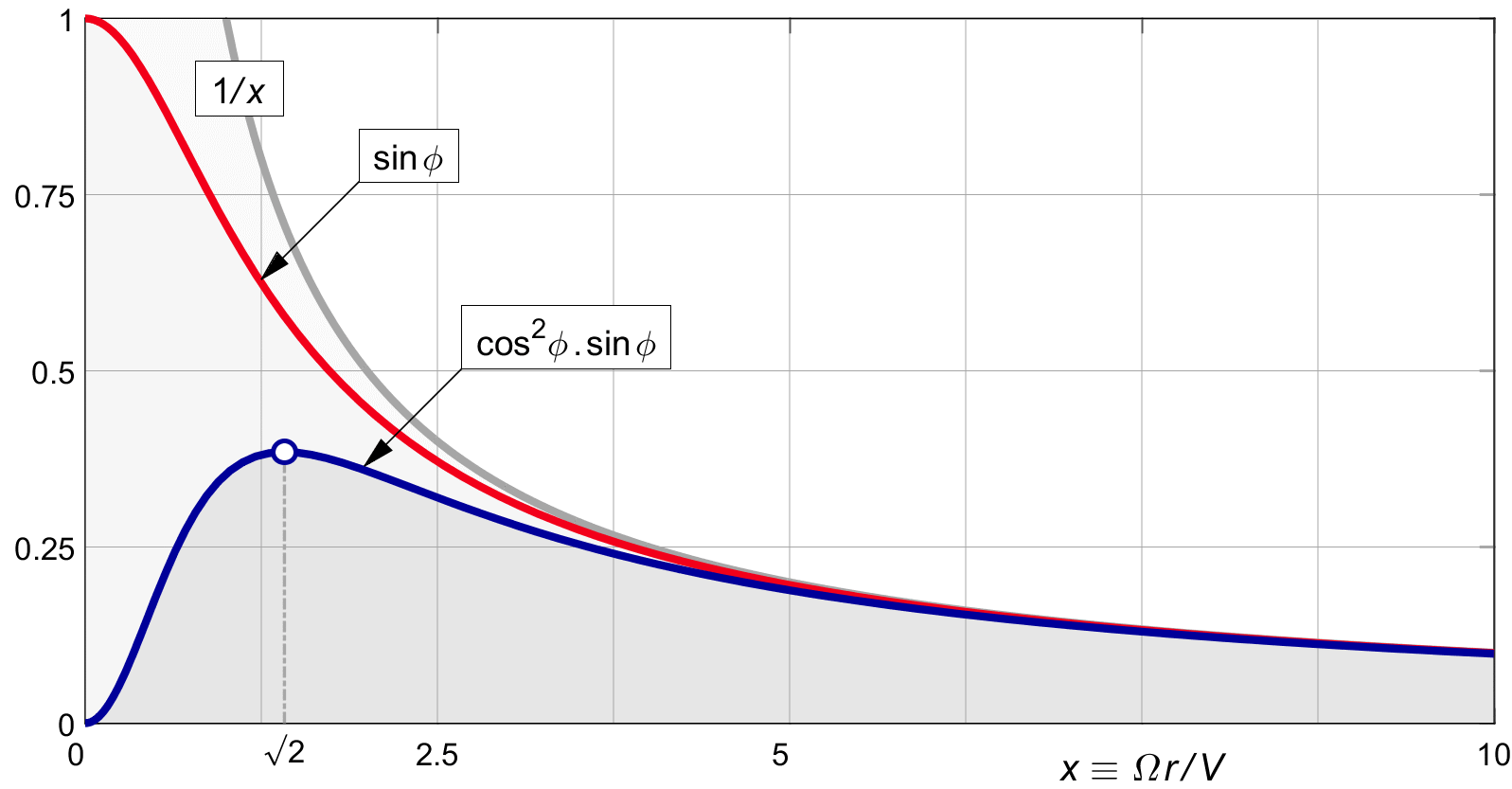
The non-dimensional blade shape for uniform loading ( i.e. without rotational optimization ) is proportional to sin φ. Figure 27.1 shows this factor against x, as a red line.
For larger values of x, we have small local pitch angles φ, where φ in φ ≅ tan φ ≅ 1 / x, and so :
| (27.13) |
The figure shows this as a grey line.
Figure 27.1 :
Non-dimensional shape factors for uniform
and rotationally optimal distributions.
Near the hub, φ ≅ 90°
and therefore sin φ ≅ 1.
The chord factor of (27.12) becomes 1 there.
Dividing this by the local
( non-dimensional ) circumference
The propeller blades become layered like a Da Vinci helicopter, or a whipped cream swirl, with the chords wrapping around the hub infinitely many times on an infinitely small radius. Such blade shapes have actually been attempted in the past, but they are both impractical and unnecessary. We will see that in the rotationally optimal load distribution, the cos2 φ term comes to the rescue.
Rotational optimization will scale the thrust by cos2 φ. With the light loading b (x) of ( 11.10 ), the non-dimensional chord (27.11) becomes :
| (27.14) |
Figure 27.1 shows this factor as a solid blue line. It differs from (27.12) by a factor of cos 2 φ / κ φ.
For small x, by ( 2.5 ) and ( 2.7 ) the factor cos2 φ . sin φ becomes approximately x2. For the local solidity we have to divide by 2π x, so the solidity goes to zero at the hub in linear proportion to x. In practice, the chord will not vanish completely, if only for mechanical reasons. Unlike the uniformly loaded propeller, the local chord and solidity do not go to infinity. The rotationally optimal propeller has a viable blade shape, right down to the the hub.
The location of the widest chord is found by setting
the derivative of
cos2 φ . sin φ
to zero.
This yields :
cos3 φ −
2 . cos φ . sin2 φ
= 0, hence
tan2 φ = ½,
hence x
= ( 1 / tan φ ) = √2 :
| (27.15) |
Plotting a little triangle with sides of 1, √2 and √3, the chord factor at this point is :
| (27.16) |
This changes (27.14) to :
| (27.17) |
Figure 27.1 indicates this widest point by a circle marker.
Figure 11.2 showed that scaling the loading by 1 / κφ to maintain the same thrust regardless of tip speed ratio X inflates the loading for propellers of lower tip speed ratio X, i.e. for propellers of high pitch. Figure 27.2 below, compared to the blue line in Figure 27.1, shows exactly the same effect on the chords.
Once again, it shows that all rotationally optimal propellers are identical in shape. They just differ in width, and blades of smaller X are "cut off" sooner.
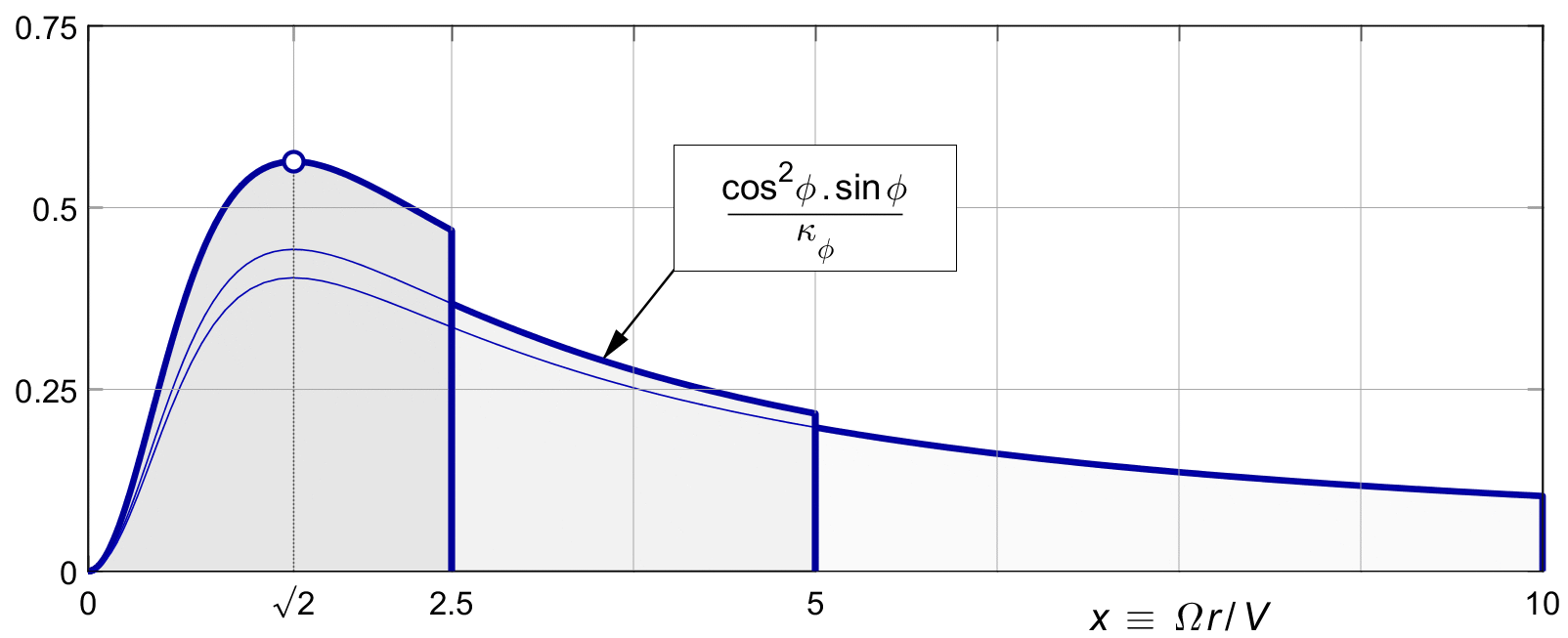
Figure 27.2 : Rotationally optimal chord for unit thrust.
The chord approximation (27.13) for large x can be kept unchanged for the rotationally optimal propeller, or we can add the κφ term if desired.
For large x, cos 2 φ is nearly 1 as we saw in Figure 10.1 . The κφ term converges a bit more slowly, see figure 11.1 , so we can write :
| (27.18) |
Since κφ is close to 1 for large X, the result is almost identical to (27.13), and follows the same grey line there.
Figures 27.1 and 27.2 showed the non-dimensional chord c ′ against x.
The non-dimensional radius runs from 0 to X. This makes it hard to compare the shapes and the relative widths of various blades, since the blade planforms extend over different tip radius lengths X.
We get a better impression of the shape variation if we plot all blades to a standard radius from 0 to 1. We achieve this by plotting c / R versus r / R, instead of c ′ against x. Relative to figure 27.2, we need to reduce both the horizontal and the vertical axis by 1 / X. With (27.9) we have c / R = c′ / X. This changes (27.14) to :
| (27.19) |
Figure 27.3 shows the result for two-bladed propellers of various tip speed ratios X. This figure is basically the same as figure 27.2, but this time all blades are scaled to a single radius. This new plot is dimensioned for our typical lightplane example of T ′ = 0.1 and CL = 0.4.
Similar to (27.18), the large x approximation is :
| (27.20) |
Figure 27.3 shows how the chord equation (27.19) works out for a few numerical examples.
The middle blade is our standard example of two blades, X = 5. A blade lift coefficient of CL = 0.4 is assumed. The other blades are the same, only for different values of the tip speed ratio X. Clearly, this has a significant influence on the blade shape and on the chords.
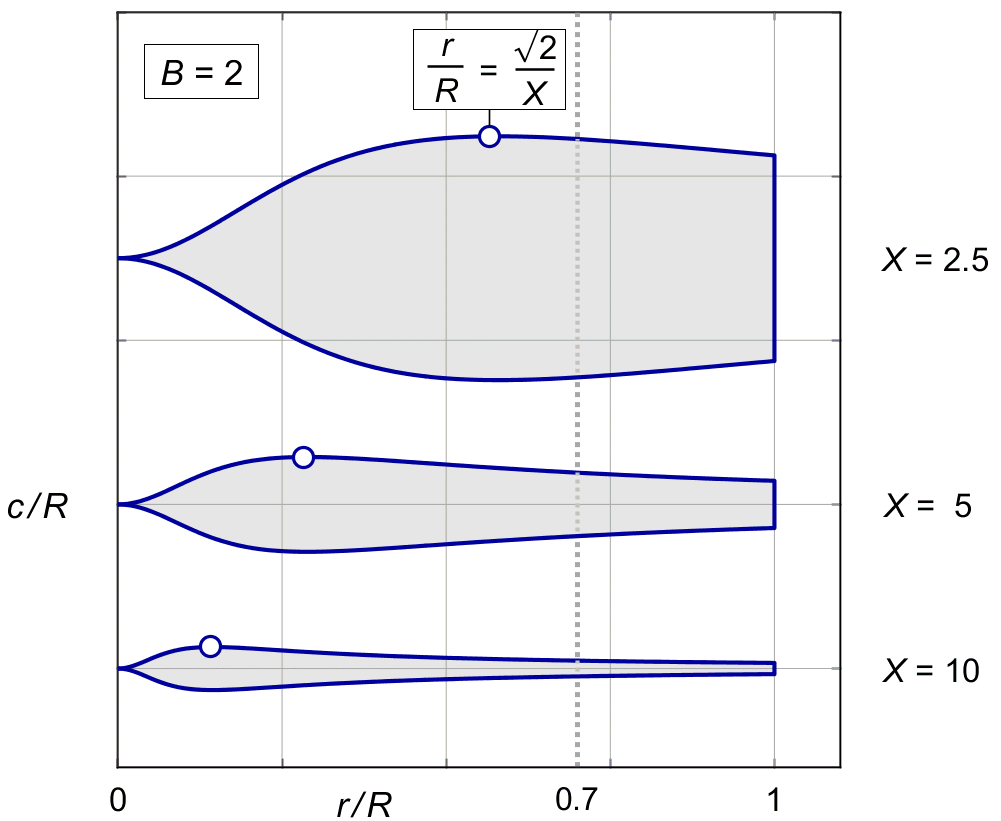
Figure 27.3 :
Rotationally optimal chords for varying X.
Two blades, thrust T ' = 0.1,
CL = 0.4.
By (27.15) the widest chord is located at r / R = √2 / X, and by (27.16) the maximum width is :
| (27.21) |
These points are marked by a circle marker. Apart from the secondary effect of 1 / κφ , all else being equal, the width at the widest chord varies with 1 / X.
At the tip, we have x = X. By (27.20) the tip chord will approximately be :
| (27.22) |
The tip chord is therefore roughly proportional to 1 / X 2.
Because in practice the tip is rounded,
it is not always the most convenient place
to measure the chord.
The typical working radius for a propeller blade is
Again by (27.20), the chord at this radius will approximately be :
| (27.23) |
Like the tip chord, the chord at 0.7 R is roughly proportional to 1 / X 2. Higher pitch propellers therefore have much wider blades, as was already obvious from figure 27.3.
With some effort, we can see that the blades have a taper of 1 / X over the outer sections, away from the widest point. We can also see that the blades all have identical shape, only inflated in lenght and width with higher pitch, but that the blades of higher pitch are "cut off shorter".
As a result, propellers of high pitch ( hence low X ) have wide paddle-like shapes, with tips nearly as wide as the widest point at x = √2. Propellers of high X are thin and clearly tapered, like a sword or dagger.