ROTATION
For a given marginal loss C, the optimal induction (10.7) will reduce the local thrust all along the blade, and especially near the hub.
We are interested in the overall thrust reduction. For this we need to integrate the thrust over all of the rings. Substituting (10.7) into the local thrust for light loading (7.14), we have :
| (11.1) |
The overall thrust is :
| (11.2) |
The integral is the weighted average of cos 2 φ over the prop disk. Its value is always smaller than one.
In a notation due to Theodorsen, we will call such overall thrust reduction factors κ ( Greek letter "kappa" ). Since the rotational reduction factor depends only on φ, we will give this particular κ the subscript φ :
| (11.3) |
With (2.7) we can write this directly in x :
| (11.4) |
The primitive of the first integrand is x 2, and that of the second integrand is ln ( 1 + x2 ). This yields the classical result for κφ :
| (11.5) |
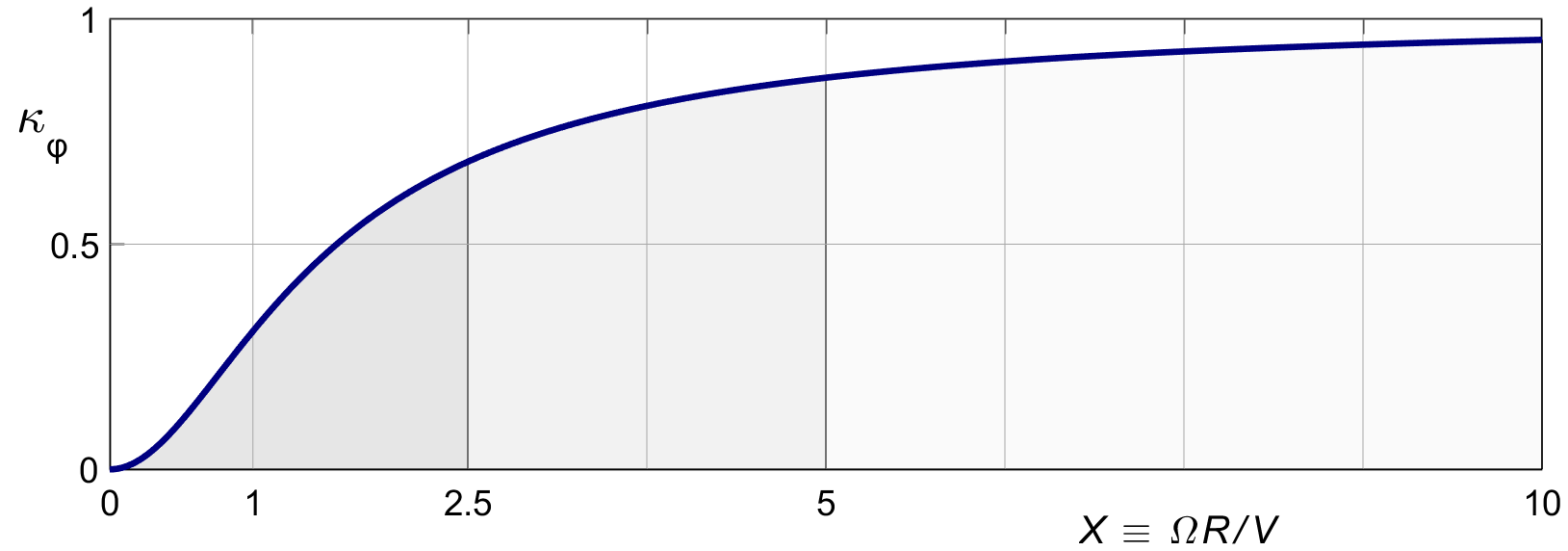
Figure 11.1 shows the graph of (11.5). This figure gives the overall thrust reduction, plotted against the tip speed ratio X. The shape is essentially different from the ring reduction shown against the ring radius x in figure ( 10.1 ).
Figure 11.1 : The overall thrust reduction factor κφ ( X ).
With κφ now known, we can rewrite (11.2) as :
| (11.6) |
which yields :
| (11.7) |
Substituting into (10.10) gives us the overall momentum loss ratio and the overall efficiency for the rotationally optimized propeller :
| (11.8) |
Substituting this into (10.11) gives us the new overall efficiency :
| (11.9) |
Comparing to (5.12) for the purely axial actuator disk, the ( optimized ) rotational loss makes the momentum loss of the propeller go up by a factor of 1 / κφ .
If we apply the C of (11.7) to the b(x) of (10.5), we have :
| (11.10) |
From (11.4) we know that κφ is the average of cos2φ over the prop disk, so we can also interpret (11.10) as a redistribution of the thrust along the span of the blade for a given thrust T ′, and write :
| (11.11) |
Figure 11.2 repeats figure 10.1, but this time for cos2φ / κφ . This normalizes the reduction factor to an average of 1 over the whole blade. In other words, it replaces the reduction by cos2φ of (10.7) by a slightly inflated version, which is a redistribution around an average of 1. The shapes in figure 11.2 all have the same unit thrust, for their particular tip speed ratio X.
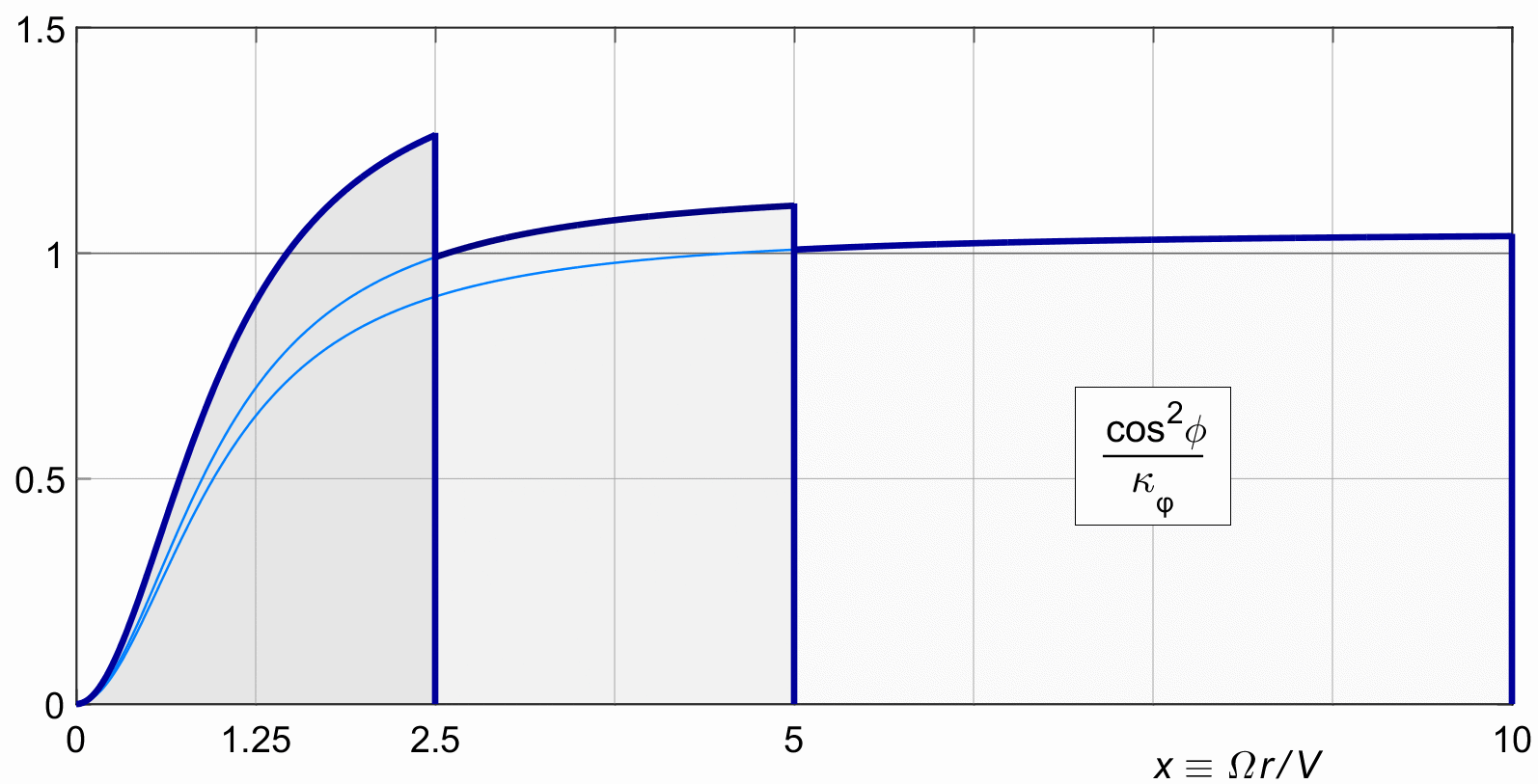
Figure 11.2 : The optimal induction for normalized overall thrust.
Figures 10.1 and 11.2 both show a memorable fact : all rotationally optimal propellers are identical in shape. The ones with lower tip speed ratio X are just cut off shorter.
Applying (11.11) to the light loading ring thrust of (7.16) yields :
| (11.12) |