The phase plane is a broad term, but we limit ourselves here to the cross-plot between the position and the velocity of a moving mass. Such a plot can be useful to get a grip on some non-linear system behaviour.
Some basic properties are :
| (1) |
| (2) |
Here x is the position, v is the velocity, and a is the acceleration of the moving mass. The dot is Newton's symbol for the derivative with respect to time. Figure 1 shows what will happen next.
The point will move to the right in the plot with the velocity x• = v. It will move faster in direct proportion to its vertical coordinate, because that represents the velocity v. At the same time, the point will also move upward at a rate of v • = a. The figure shows that the resulting motion has a slope of a / v.
A simple corollary is that the slope is "infinite" for v = 0. This is obvious anyway : since v = 0 means x • = 0, a point on the horizontal axis can only move vertically away from it. In other words, the trajectories can only cross the horizontal axis orthogonally.
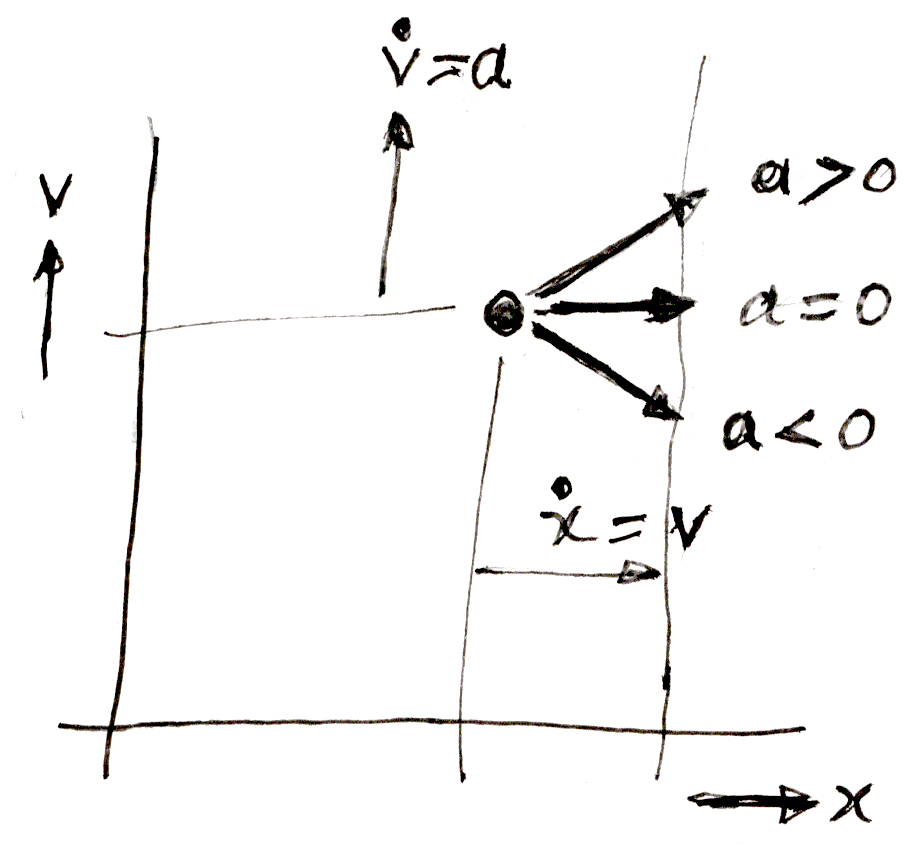
Figure 1 : Phase plane acceleration.
From high school math we remember that when starting from standstill, the movement for a constant acceleration is described by :
| (3) |
| (4) |
Suppose we can accelerate a mass with a maximum acceleration amax, and maximum deceleration −amax. Substituting t from (3) into (4) we have :
| (5) |
This is the equation of a parabola, but since it expresses x in terms of v, the parabola lies its side in the phase plane plot. Figure 2 shows the result. If we start from rest in the origin, then accelerate for a certain time T, and then decelerate to zero again, we will have covered a distance of x = ½ amax T 2, in a time 2 .T.
Halfway, we reached a maximum velocity of v = amax . T. For the maximum acceleration that was available, this distance could not have been covered faster. This is why this is called a "minimum time manoeuver".
The "control law", if you like, that underlies this manoeuver is : maximum to halfway, and negative maximum over the second half, starting the deceleration "just in time". This strategy is aptly called "bang-bang control". It is highly nonlinear. The phase plane method lends itself very well to the analysis of nonlinear control laws.
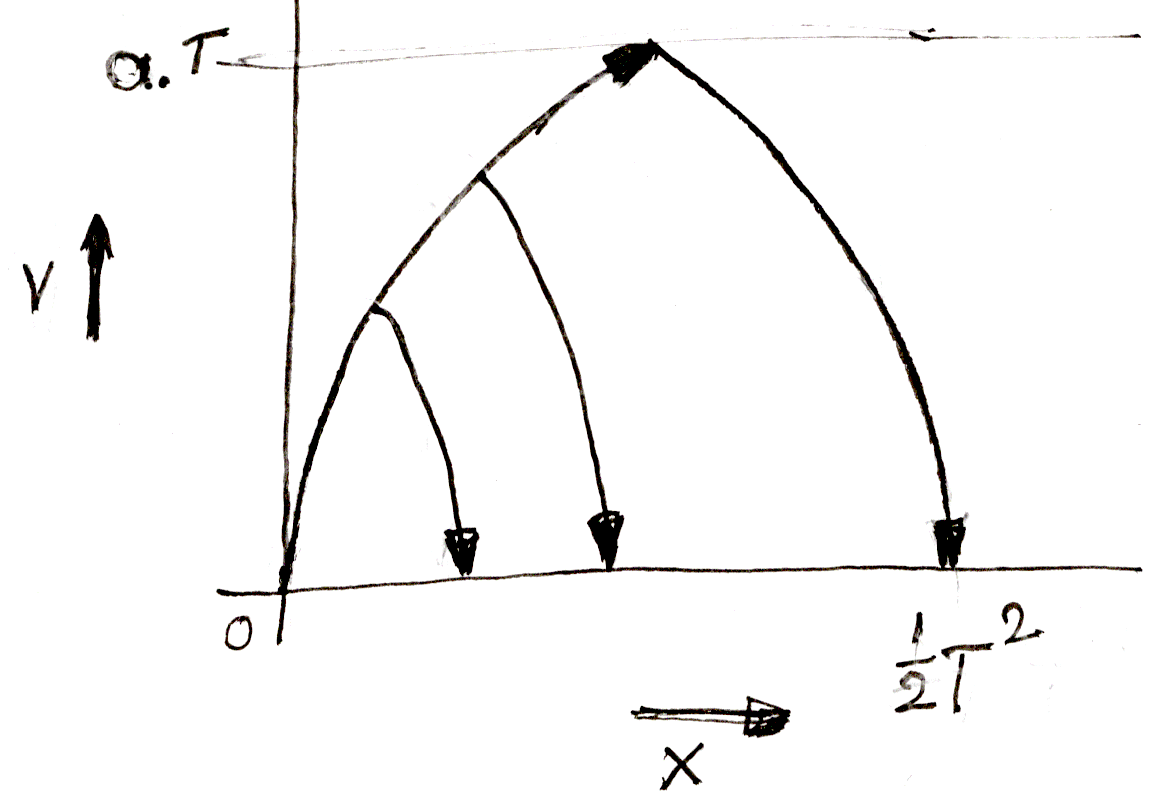
Figure 2 : Minimum time manoeuvre.
Another quite common constraint is that of a maximum velocity. Taken to the extreme, we have instantaneous v = vmax, with a distance covered of x = vmax . T. This trajectory shows up in the phase plane plot as a block.
If both a maximum acceleration and a maximum velocity apply, we get Figure 3. This combines the parabolic sections of Figure 2 with a straight intermediate stretch of constant maximum velocity and zero acceleration.
This constant speed part is often called the "coasting phase". The equations are more or less obvious, if T is the coasting period.
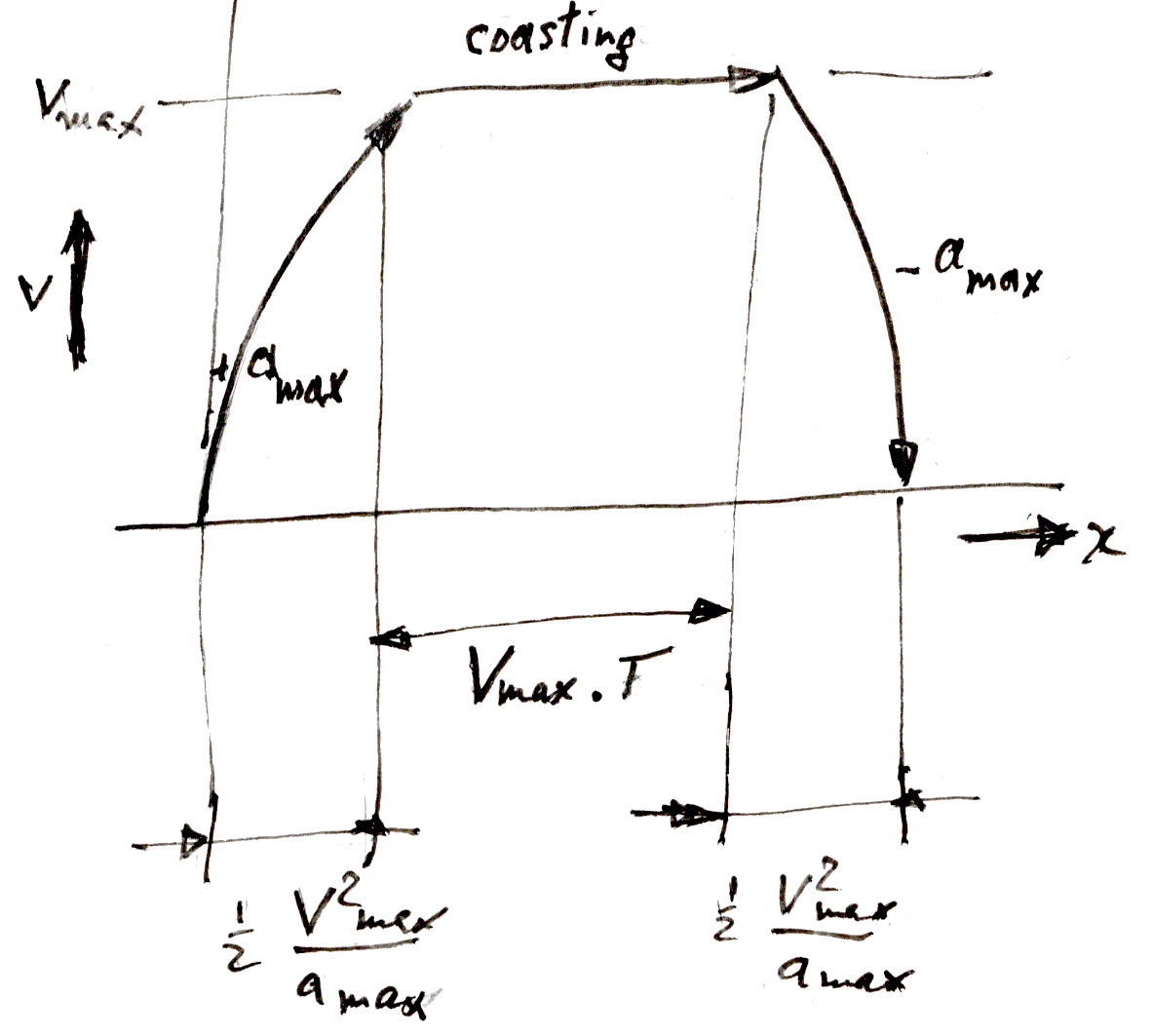
Figure 3 : Minimum time with coasting phase.
We briefly discuss the case of a pendulum, or a mass-spring-damper system.
This is a linear system, and the phase plane plot is not very useful in this case. We discuss it only because the plot bears a superficial resemblance to the far more useful eigenvector plot, and we wish to prevent any confusion between the two.
The equations of motion for a mass-spring-damper system centered on the origin are :
| (6) |
Here m is the mass, k is the stiffness, and b is the damping.
From this we see that for x = 0 :
| (7) |
This shows that the vertical axis is crossed
at a slope of
v• / x•
= a / v =
−b / m.
From (2) we concluded that the horizontal axis
This allows us to sketch the trajectory as in Figure 4. From the signs in (2), the point will always move clockwise. The trajectory is a kind of slanted spiral. We will see elsewhere that the eigenvector plot is more appropriate to this problem, and that it produces a true spiral which by convention rotates anti-clockwise.
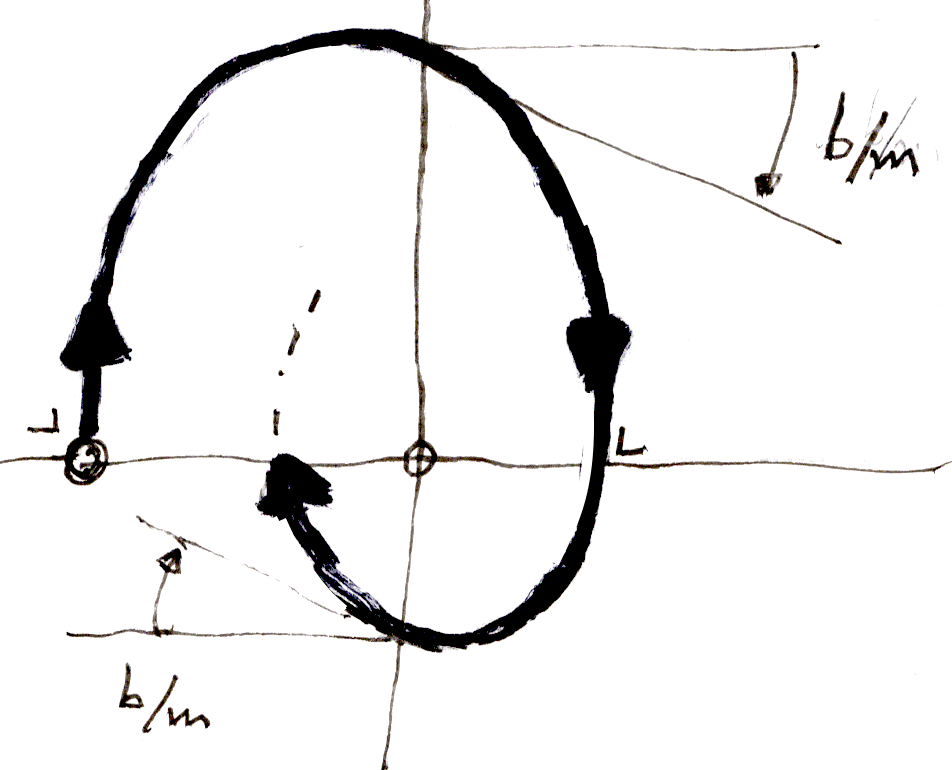
Figure 3 : Mass-spring-damper system.