1 Hand linkages
1.1 Introduction
These web pages primarily discuss hand linkages, as opposed to mechanisms and linkages in general.
The distinction will become clear as our story progresses.
linkage design
Hand linkages typically consist of light pushrods, bellcranks, torque tubes and cables. The video below shows a classical example using all of these, to allow hand manipulation of radioactive material from a safe distance.
We will analyze linkage components and their interactions in some detail below.
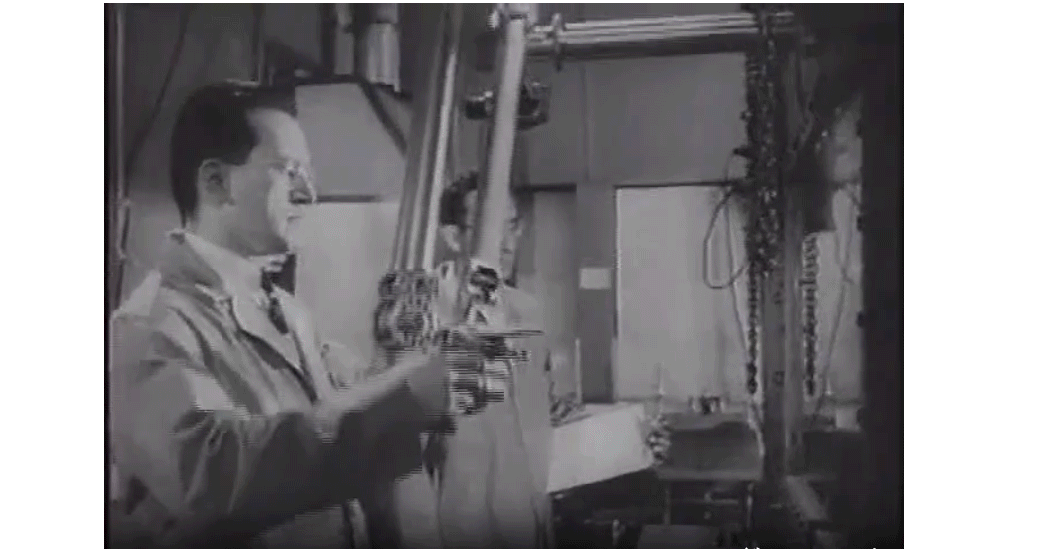
Figure 1.1 : Goertz nuclear lab manipulator.
haptic requirements
The word "haptic" means : "relating to the sense of touch".
As a technology, it means either "touching at a distance" or "artificial feel". If the intermediary is anything more complex than a pointing stick, then it is called a "haptic device". In the past, the technology also used to be known as "force feedback".
Touching is a two-way street. First, we have to be able to reach out and touch something. Then, we need to be able to feel the contact force coming back from the environment.
To reach out and touch, the haptic device has to be reasonably low weight. To feel forces from the remote environment, it has to be reasonably stiff. In both directions, we need low friction.
We will attach numbers to these requirements in a later chapter.
application areas
Hand force mechanisms are common in aircraft flight controls,
but also in haptics
We will have a look at these applications later. Our own motivating example will be hand manipulation from a distance in an MRI environment. We will discuss that application at the end of this note.
2 Bandwidth
2.1 Servo mechanisms
Mechanisms for moving objects around are called "servo mechanisms", from the Latin "servus" for slave. A central concept in servo mechanisms is the so-called "bandwidth". Loosely defined, it is the highest frequency at which the mechanism can accurately move the remote object around.
Haptic linkages are typically used to touch, or even move an object from some distance away. The remote object may be virtual, as in classical haptics, or it may be physical, as in so-called "master-slave" systems. It is interesting to apply the concept of a bandwidth to a haptic linkage as a quality measure, but it is not immediately obvious how to apply it, because a haptic system is a two-way street.
If we use the system to move objects around in a real or virtual world, then we may be interested in how faithfully the remote object will follow our hand movements, much like in a conventional servo system. But if we wish to monitor events in the remote world like the "collision" forces when we touch a remote object, then the bandwidth works the other way, and it is our hand which is moved, or stopped by the remote environment.
In both cases the linkage transfers a fixed position at one end, to a moving mass at the other end, but the direction ís different. In a master-slave system, our hand is the reference position, and the remote object which we pushed or "grabbed" must follow. But for the sense of touch, the remote object is the reference position, and it will reflect a force back to the mass of our hand, and of the joystick it may be holding. If our hand would have no mass, then it would just move away from the force, and we would feel no contact force from the remote site, just a motion.
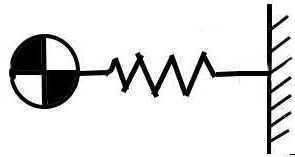
Figure 2.1 : Mass flexibly connected to a reference position.
Figure 2.1 shows a moving mass, connected to a reference position by a flexible mechanism. The mechanism is modelled as a single spring. The reference position is shown as a fixed wall. It may be your hand, or an object in the remote or virtual world.
If the reference position is moved slowly, the mass will follow obediently. If the reference position is vibrated very fast, the mass will not be able to follow at all. It will just sit there in a sort of average position.
The typical frequency separating the two domains is the resonance frequency of the mass on the spring. When driven at the resonance frequency, the mass will oscillate wildly, and when driven faster it will no longer respond. With some damping we can use the system up to the resonance frequency, but not beyond. For this reason, "bandwidth" is often used interchangeably with resonance frequency.
Without going into the math involved, the resonance frequency of a mass on a spring is :
| (2.1) |
| (2.2) |
We will often work with the compliance C ≡ 1 / K, instead of with the stiffness K. In that case we have :
| (2.3) |
The resonance frequency is inversely proportional to the square root of the mass, and it is also inversely proportional to the square root of the compliance. A large mass on a soft spring will have a low resonance frequency. A small mass on a stiff spring will oscillate much faster.
3 Serial linkages
3.1 Stiffness and mass
A haptic linkage typically consists of separate elements like cables or pushrods. Each element will have a mass and a stiffness. The mechanism is usually serial, i.e. the components are chained end to end, like in a series of pushrods. Figure 3.1 shows the principle.
The mechanism is approximated by a series of "lumped masses", connected by massless springs. We could think of the first mass as the mass of a knob or handle, the second mass as the middle of a pushrod, etcetera. The final mass is that of a physical "feeler", or of the connection to a haptics device.

Figure 3.1 : A serial mechanism.
We will first establish what the mechanism is going to feel like for very slow movements. If the mechanism is not in contact with the (virtual) environment, then softly pushing on the other end will move the whole chain to the right (almost) without compressing the springs. The mechanism will feel like the rigid sum of all the masses in the chain :
| (3.1) |
We will see in the next section that this mass is, somewhat surpringly, reduced at higher frequencies.
If the mechanism is in contact with a stiff (virtual) environment, then slowly pushing it in will compress the springs without generating any mass forces. The mechanism will not feel like the sum of all the stiffnesses however : if one stiffness would be infinitely large, the whole mechanism would not feel infinitely stiff ! Instead of summing forces, we should be summing displacements. The displacement per force is called the compliance. It is the inverse of the stiffness :
| (3.2) |
At "zero speed", the mechanism will feel as soft as all of the compliances in series. The numbering of the compliances may be different from that of the masses, but that does not affect the principle :
| (3.3) |
3.2 Distributed masses
We know from theory that a mechanism like the one in Figure 3.1 has as many resonances as there are masses in it. At the highest frequencies, all the masses will rattle in opposite directions. We cannot reasonably use the linkage there.
For practical purposes, we only need to know the lowest resonance frequency. In fact, we would like to simplify the system to a single mass, representing only the lowest mode.
The general solution is not trivial, but fortunately there are shortcuts. If the mode shape is known, we can esily calculate the spring forces and the mass accelerations, and find the eigenfrequency. In a method due to Rayleigh, we can simply make an educated guess for the mode shape and see if it makes sense.
Quite often, the masses at the ends are much larger than the masses along the linkage itself. When oscillating, the stretch of the springs is dominated by the forces between the end masses. The mass forces on the "beads on a string" do not contribute much. All of the springs wil carry the same force, and if they have similar stiffness, the same stretch.
For a series of identical masses and springs, this amounts to a mode shape where all the oscillating masses are evenly spaced. The outcome of the calculation is that the equivalent lumped mass is one-thirds of the sum of the individual masses :
| (3.4) |
The result makes sense. The masses closest to the attachment (or drive) point do not move nearly as much as the ones at the far end, and kinetic energy goes with the square of the motion, which on integrating explains the factor of ⅓. With an external mass M attached to the far end of the linkage, the total oscillating mass becomes :
| (3.5) |
This may not be exact, but it is one step better than ignoring the mass of the linkage altogether, and in many cases this is good enough as an approximation.
So far, we avoided specifying which end of the chain is the driving end, and which is the free one. All we know is that near the bandwidth, the linkage mass dynamically shows up as a mass of ⅓ m at the free end. In a purely speculative way, we could portray the system as in Figure 3.3. This has no basis in real fact, but it could account for the effect of the linkage mass without specifying which side is the driving one, and which the free end.
This model would suggest that near the bandwidth, a collision at either end would present a mass one-third of the linkage mass.
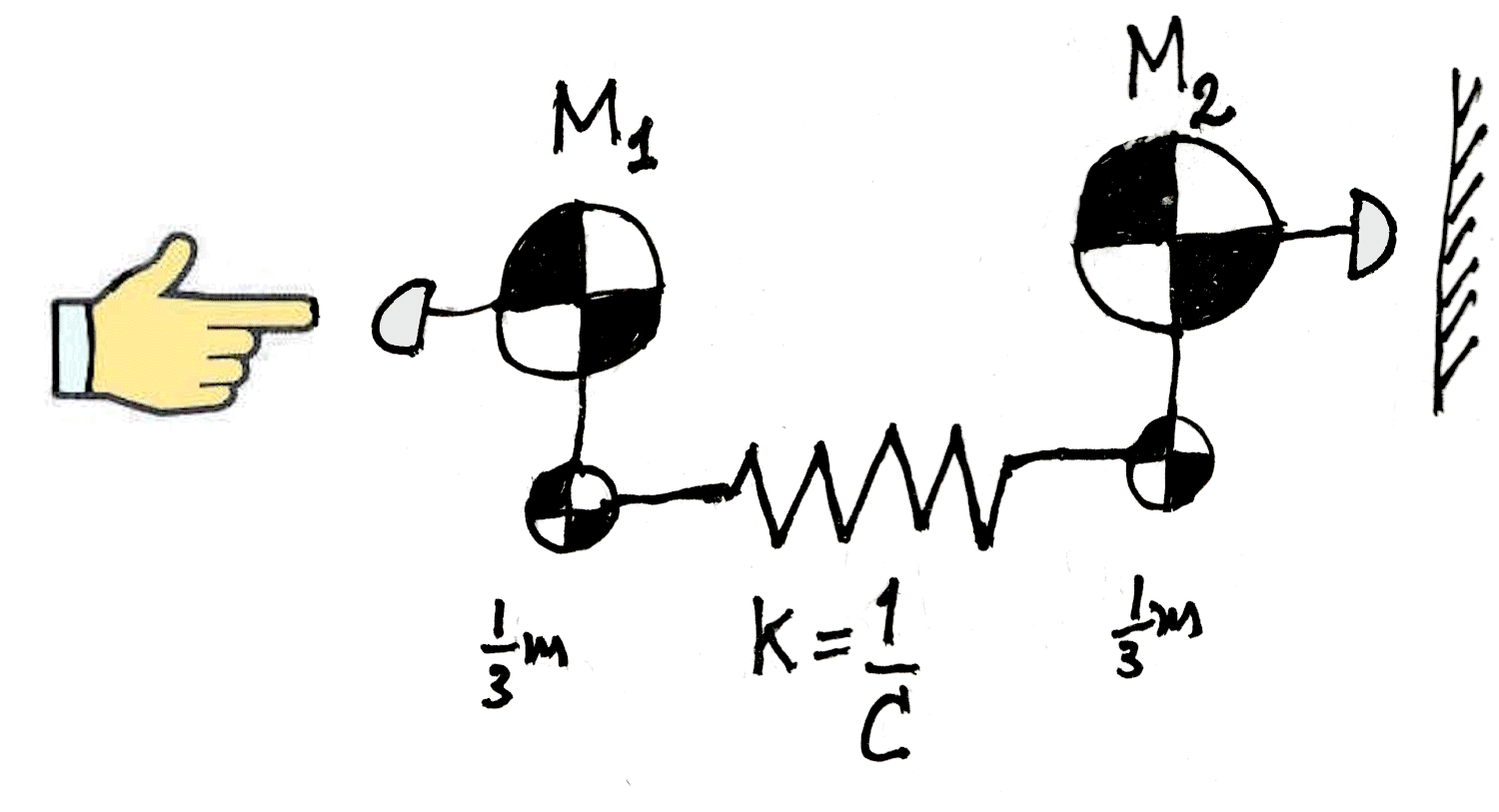
Figure 3.2 : Two-sided approximate model.
If one of the ends is blocked or very heavy, this simplified model will perform well. If both masses are free and equally heavy, it will exaggerate the spring mass, since due to symmetry the model will oscillate with a node in the middle standing still. Both halves will behalve like a fixed-free spring with double the stiffness and half the mass of the full length spring. The end masses would have to be ⅙ of the total spring mass instead of ⅓, so the model is certainly not perfect. It is just an indication of orders of magnitude.
4 Reflected properties
4.1 Finding a common denominator
Figure 3.1 showed a typical haptic linkage, as a chain of mechanical components.
Not shown in the figure is that along the chain, gearings or lever ratios may be hiding. This is not a problem, but it does mean that the various elements do not have the same travel in motion, or the same one-on-one force transfer. A force applied to one end of a ( massless ) lever will not give the same force at the other end of the lever. They will stand in the inverse ratio of the lever arm lengths.
To avoid comparing apples to oranges, we will have to choose a reference lever angle or an axial displacement point to which we reference all other forces and displacements. Stiffness, mass ( and to a lesser degree, friction ) in the longer travel, faster moving parts of the mechanism make themselves felt at the reference position much more strongly than the same parts moving on short lever arms. Historically, we call this process of converting all stiffnesses and masses to the same scale "reflecting".
The reference location does not even have to be a physical location in the mechanism, although usually one of the end effectors is chosen. For manual operation, a location with linear displacement is often more intuitive than a rotating one. A linear movement will give a linear "spring" stiffness and a simple mass. For most people, these are more intuitive than torsional stifnesses and moments or inertia.
4.2 Reflected displacements
Figure 4.1 shows a typical mechanical lever, with input point A and output point B. To keep our life simple, we look at the horizontal displacements of the end points. The ratio between these two displacements is :
| (4.1) |
Here we introduce the "gearing ratio" GAB between an "input" displacement A and an "output" displacement B. This generalizes easily into the displacement ratio between motions in other linear directions, or even via gearboxes and pulleys.
As a sign convention we give all displacements the same sign when the mechanism moves in one direction.
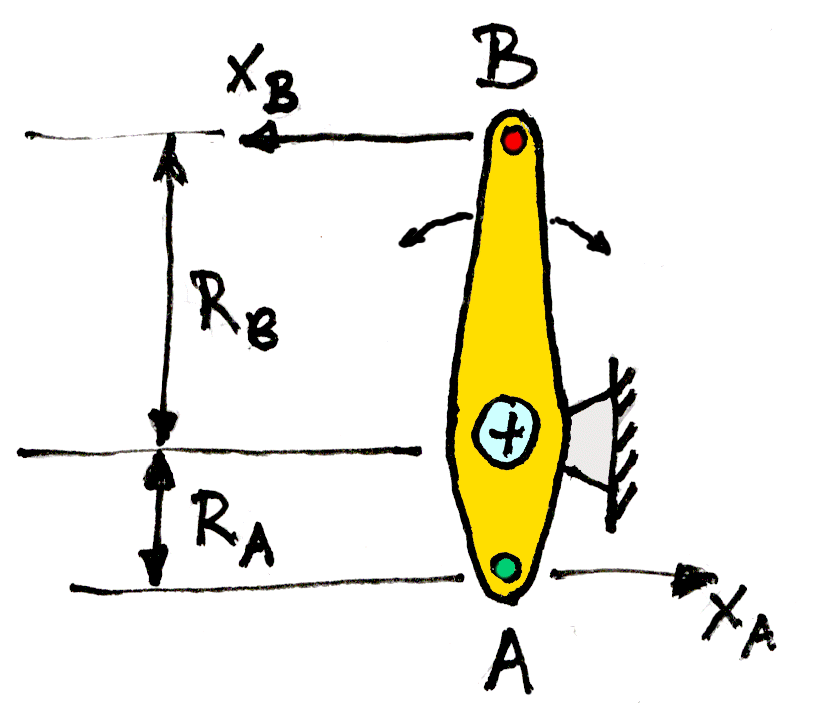
Figure 4.1 : Lever ratio from A to B.
4.3 Reflected forces
Now apply an input force FA at point A of the lever in the direction of xA. For a stationary or massless lever, the output force at B will be :
| (4.2) |
This follows directly from the equilibrium of moments of the lever around the support point.
The force transfer ratio is inversely proportional to the displacement transfer ratio. It is interesting to note that this also follows from conservation of energy. Since work done on the lever equals force times displacement, then if the lever does not store energy, we need :
| (4.3) |
With conservation of energy, (4.2) follows immediately from (4.1).
Because of this force gain, the inverse of the gearing ratio is sometimes called the "mechanical advantage".
4.4 Reflected stiffness
With the reflected force and displacement in hand, we can also reflect stiffnesses and masses from one location to another. Figure 4.2 shows a stiffness and a mass applied at a point A. We will reflect them to a differently "geared" point B.
The definition of the stiffness in a point A is the force per displacement there :
| (4.5) |
From (4.1) and (4.2) we have :
| (4.6) |
The gearing ratio GAB appears squared in this relation. The reason is that if point B moves more than point A by the gearing ratio, the spring in A will be less compressed in that ratio. At the same time, the spring force in B will be reduced by the same ratio.
Taken together, a stiffness is reflected by the square of the gearing ratio:
| (4.7) |
If we compress a spring element by a long lever, it feels less stiff for two reasons. First, we exert a greater force on the spring element. And second, our end point moves more for a given deflection of the spring element.
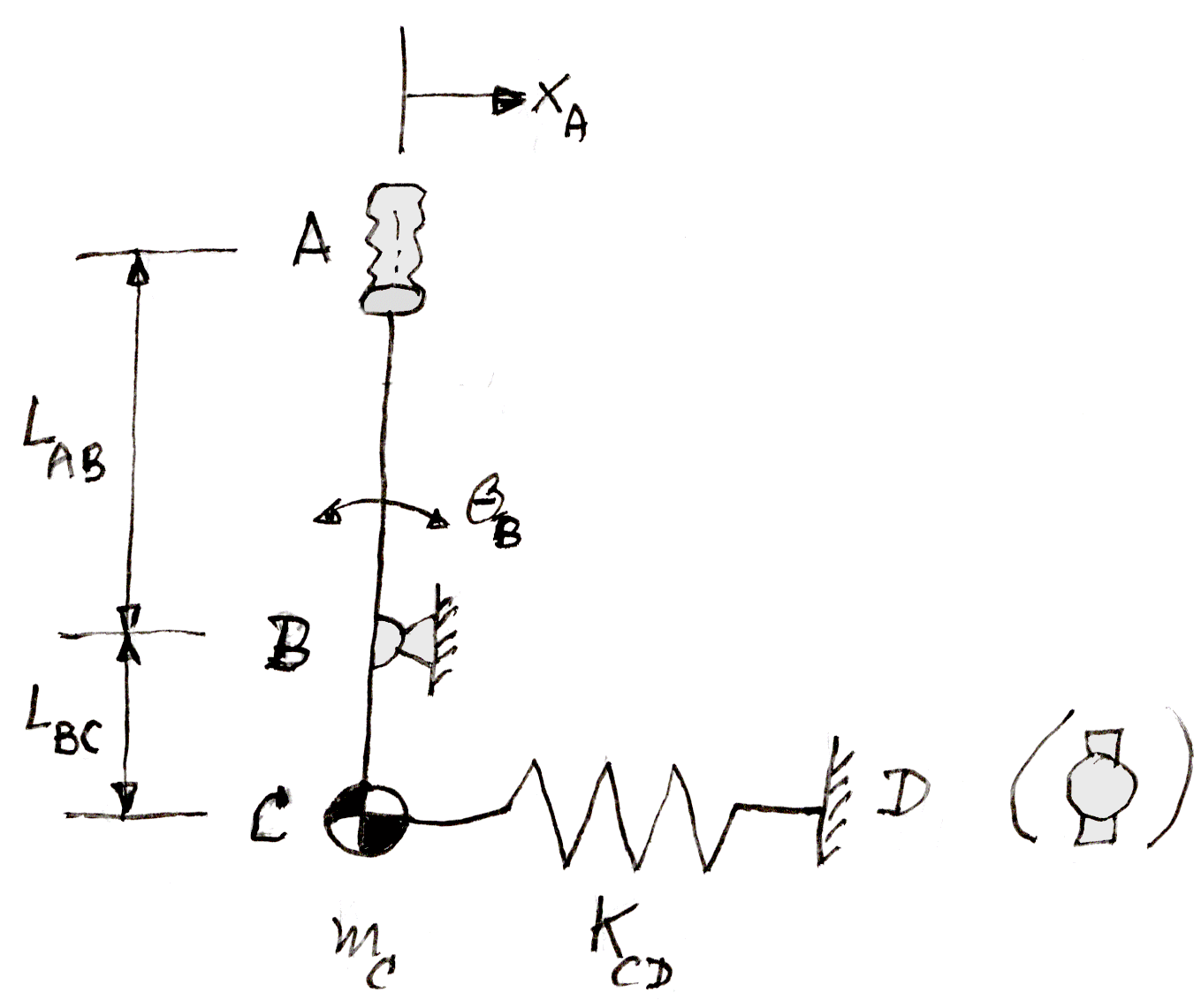
Figure 4.2 : Reflected stiffness and mass.
4.5 Reflected mass
According to Newtons's law, the force needed in A to accelerate the mass in A is :
| (4.8) |
The raised dot "●" is Newton's symbol for "derivative with respect to time", so two dots means the acceleration. This is just Newton's law F = m . a.
If we apply (4.1) and (4.2) in the same way as we did for the stiffness, only this time for the accelerations, we find the exact analog of (4.7), only this time for the mass :
| (4.9) |
Like for the stiffness, the mass of A "reflected" to B is proportional to the square of the lever ratio.
If we try to accelerate a mass on a long lever with a short lever, it will feel heavier for two reasons. First, we are trying to accelerate the distant mass more, on a longer lever. Second, the "mass force" also acts on the longer lever, so that the force at our end becomes correspondingly larger.
4.6 Reflecting rotating parts
Most mechanisms will contain rotating parts like pulleys, levers, bellcranks, or even torque tubes. The equivalent of Newton's law (4.8) for a part rotating around a pivot point A reads :
| (4.10) |
Here T is the torque around the pivot point, I is the so-called moment of inertia, and θ ( Greek letter theta ) is the angle of rotation, measured in radians.
We can write the example of Figure 4.2 in terms of the rotation of the lever.
For small angles of rotation
| (4.11) |
A force F acting on a lever arm R becomes a torque T :
| (4.12) |
A mass pivoting on a lever arm presents a moment of inertia :
| (4.13) |
With these definitions, Newton's law for rotations (4.10 ) is identical to the familiar (4.8) for linear motions.
The linear stiffness acting on a lever length RA translates into a torsional stiffness :
| (4.14) |
4.7 Reflected bandwidth
The rotating equivalent for the linear resonance frequency (2.1) is :
| (4.15) |
From (4.14) and (4.15) we know that both Kt and Ip scale with R2. This means that the bandwidth of a lever with a single spring and mass attached to it is independent of the lever length.
This obviously holds in point A of Figure 3.1, but it also holds in point B. This may briefly come as a surprise, but on further reflection it makes perfect sense. There is no mass in B. It is just a mathematical point with no mass of its own, and it will not affect the natural frequency of the mass oscillating on the spring. If the user moves point A back and forth at a given rate and with a given amplitude, then the forces at A will be smaller with a longer lever B. The lever will move quadratically “lighter”. This applies to both the spring force and the mass.
But when we release the lever, it will oscillate at the same rate as before.
Things will be different if more levers are combined. In that case a mass or spring on a long lever will have more ínfluence on the resonance frequency of the whole system, than if they acted on a shorter arm.
4.8 Reflected friction
Linkages, especially cable mechanisms, have internal friction. Friction comes in at least two varieties. There is the so-called viscous friction, a force which is proportional to the first derivative of the displacement. This follows the same reflection rules as stiffness ( a force which goes with the displacement), and mass (a force which goes with the second derivative of the displacemnt). It is usually small, and almost always beneficial, because it provides smooth dampoing, and no offset at zero velocity.
There is also the so-called "Coulomb", or dry friction. This is not proportional to the displacement velocity, only to its sign(i.e., its direction). Coulomb friction therefore only reflects with the force, not with the displacement.
Coulomb friction is a mixed blessing. It provides some damping, but it spoils the smooth feeling of free motion.
| (4.16) |
5 Materials
5.1 Aluminium
Before we discuss linkage components, it will be useful to list a few typical material properties. The classical material for lightly loaded linkage components is aluminium. This has the following mechanical properties related to stiffness and mass :
| (5.1) |
Stiffness and specific mass are the same for all aluminium alloys. They are properties of aluminium as an element. We note that G ≡ 0.4 E, which is true for many materials. The shear stiffness is less than the tensile stiffnes by this ratio. Strength ( tensile and shear ) does vary widely with the alloy. For a high performance aerospace alloy like 7075 we have :
| (5.2) |
Like for the stiffness, the material is less strong in shear than it is in tension, but the difference is less pronounced. Everyday linkages are typically designed for stiffness, not for strength, and in that case the building grade varieties of aluminium will suffice. The values for Al 6060 are quite very variable depending on the heat treatment, but some ballpark figures are :
| (5.3) |
5.2 Carbon tubes
Carbon components are made up of fibres, laid in specific orientations in a matrix material which is usually some form of resin.
Carbon tubes normally have most of their fibers oriented lengthwise, and they are strong and stiff only in that direction. Special tubes with diagonal weave are also available, but they are much less common. The lenghtwise-oriented tubes are most suitable for pushrods.
The value of G is extremely low for tubes with parallel fiber orientation. These tubes are totally unsuitable as torque tubes. Special tubes with diagonal fibers are needed there, but these will have less longitudinal stiffness.
| (5.4) |
Tensile strength varies even more widely than in aluminium, but it is very high. However, these tubes are unsuitable in shear, and hence in torsion :
The ratio between the allowable tensile strength and the stiffness is much higher in carbon tubes than in aluminium. Euler buckling will be dominant even for low slenderness ratios, like 30 or more. TBC As a result, dimensioning of carbon fiber tubes will generally be dominated by buckling.
5.3 Stranded steel wire ( Carl Stahl )
Cables running over pulleys are used extensively in hand force linkages. The most common, and really the only suitable material is stainless steel wire rope. Cables built from other materials like nylon, Dyneema, Kevlar and similar have some attractive properties, but in practice they are subject to excessive long term creep, and in addition they are very hard to anchor securely since even the most complicated knots or clamps tend to slip.
Stainless steel wire rope is typically built from many strands of very thin wire. Figure 5.1 gives the cross-section of the most durable and flexible type, the 18 x 9 + 7 x 7, where a rope of typically 1 mm diameter or less consists of 211 wires, arranged in groups cross-stranded at every level to counter any tendency of curling.
This finely braided cable can be run around pulleys down to 16 times the diameter of the rope without unduly compromising its fatigue life.
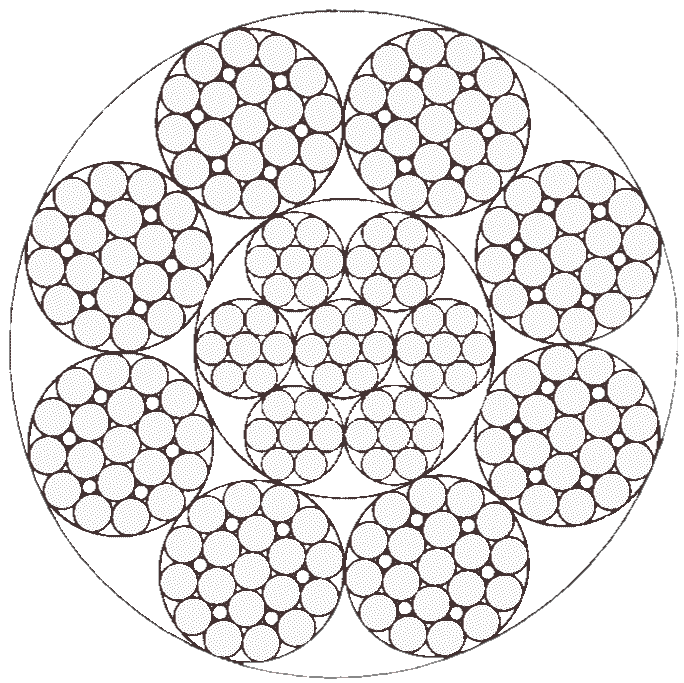
Figure 5.1 : Cable cross-section 18 x 9 + 7 x 7.
The Carl Stahl catalog quotes a material breaking stress of
1670 N / mm2,
far exceeding the values of 500 to 750
| (5.4) |
Values for the stiffness are much harder to find, but one source quotes an equivalent elasticity modulus E of 42.25 e9 N/m2 for the 1.2 mm cable in the figure. This is about 20% of the stiffness of a solid steel wire of the same diameter, where E ≅ 210 N/mm2 :
| (5.5) |
6 Cross-sectional shape properties
6.1 Thin walled tubes
We will be needing some cross-sectional shape properties for tubes and shafts, in particular the frontal area A and the polar moment of inertia Ip. The exact equations can be looked up in any text on strength of materials, but for a thin-walled circular tube, a very useful approximation is :
| (6.1) |
The exact equations for a solid shaft are in R 4, and a tube is the subtraction of two solid shafts with radii of R and ( R − t ) . Equations (6.1) are the first order approximation of this difference, conveniently losing the term in R 4, and all higher order terms of t / R.
For reasons of symmetry, the moment of inertia Ixx of the frontal area around a cross-axis is exactly half its polar moment of inertia, and so :
| (6.2) |
These approximations can be improved slightly by replacing R by a radius R* for the middle of the wall thickness, or of course by using the exact formulas :
| (6.4) |
The relationship between A and Ip is also clear without calculation, because Ip is the frontal surface area multiplied by the square of the radius at which this surface area is located.
In a thin-walled tube, all the material is located on the radius R, and so the following applies:
| (6.4) |
A tube of length L has a mass of m = ρ . A . L, and so the polar mass moment of inertia of a tube is :
| (6.5) |
6.3 Solid shafts ( or disks )
In a solid shaft, not all mass is located on the outer radius. It is distributed over all radii. The polar moment of inertia is the integral of the squares of the radial distances. This works out to half the value for a thin walled tube, of the same mass.
| (6.6) |
7 Mechanical components - stiffness and mass
7.1 Typical linkage components
We will now run by a number of individual structural elements. This chapter discusses stiffness and mass. The next chapter will discuss strength and structural weight.
We will briefly mention a few more exotic components for negotiating complex curves, viz. so-called Bowden cables, and hydraulic lines.
7.2 Pushrods
The first, and probably most useful linkage component is the pushrod.
stiffness
The stiffness of a pushrod per length equals its modulus of elasticity times its cross-section :
| (7.1) |
For a thin-walled tube, from (6.1) we have :
| (7.2) |
pushrod mass
The mass of a pushrod equals its specific mass multiplied by the material volume. The material volume equals the cross-sectional area times the length :
| (7.3) |
With the cross-sectional area A from (6.1), this equals :
| (7.4) |
pushrod reflected mass
The pushrod lives at the end of a lever. The angular motion of a lever is typically +- 30° to +- 45°. Since this holds for all levers along the linkage, all levers in a linkage typically have roughly the same length, perhaps with the exception of the end effector or the joystick at the end.
The reflected mass of the pushrods in a linkage typically scales with the square of the ratio between the length of the joystick, and that of the internal levers. A typical lever length is 0.05 m. Pushrods usually do not contribute much to the apparent moving mass of a linkage.
pushrod bandwidth
Dividing (7.1) by (7.3), we get a figure of merit for the "bandwidth of a pushrod" like in (2.1) :
| (7.5) |
Substituting the ρ and E for aluminium from (5.1), we find that the bandwidth of a single pushrod is many hundreds of Hertz. Pushrods are extremely effective linkage components.
7.3 Cables
Cables are very common components in hand linkages. Their main raison d'être is their flexibility in negotiating pivot points with more than one degree of freedom, and overall angles of more than 45°.
If applied correctly, cable drives can have lower structural weight than pushrods. Apart from that, they are inferior to pushrods in every respect, including stiffness and especially, reliability.
travel
Cables typically have much larger travel than pushrods. They are much like thin pushrods, but due to their small diameter and due to their stranding, they are much less stiff lengthwise. This is partly made up for by allowing cables a much longer travel than pushrods.
The longer travel of cables is possible because along the way, they can be run over pulleys or sliding blocks instead of levers, which means they are not limited by the ± 45° lever travel that pushrods typically have to contend with.
pretensioning
A downside of cables is that they can only be "pulled". This is normally solved by pretensioning, and using "reduced pull" to replace "increased push". The usual way of pretensioning is by using cables in opposite pairs, but in rare cases counterweights or springs at the ends are used.
When using cables in pretensioned pairs, the net linkage stiffness is twice that of a single cable. If one of the cables goes slack, the linkage stiffness is halved to that of a single cable. This happens when the net linkage force exceeds twice the pretensioning force. At that moment, one cable carries twice the pretensioning force and the other just reached zero. This typically occurs near the maximum net force that the linkage is designed to transmit.
One advantage of pretensioning is that the pulleys are loaded with a constant force, independent of the torques that the cables transmit. This somewhat unexpectedly renders the cable anchor points on the surrounding structure "infinitely stiff" with respect to the forces transmitted.
pulleys
In between the ends, cables are normally run over pulleys. Over long straight sections, or if the local direction change is small or zero, the cable is simply run through holes in nylon blocks to prevent sagging and cable slap.
Depending on the "cable construction" ( number and arrangement of strands ), cables can be bent less or more. The most flexible, and really the only acceptable construction for light running cables is the 18 x 9 + 7 x 7 cable of Figure 5.1. This cable can be run around pulleys of 16 times its own diameter without undue wear :
| (7.6) |
cable guards
winches or "capstan drives"
end quadrants
At the end of the linkage, the cable drive will often end on a pivoted joystick. For longer cable travel, a lever length of 0.15 m is more typical than the 0.05 m of pushrod drives. This will restore the reflected stiffness of the cable relative to that of the typical pushrod by a factor of 9 or so, and the strength by a factor of 3. This is often needed because cables are less stiff and strong than pushrods by at least that ratio.
Cable drives can be compact along the way, but they tend to take up a lot of space at the ends if an end quadrant is needed.
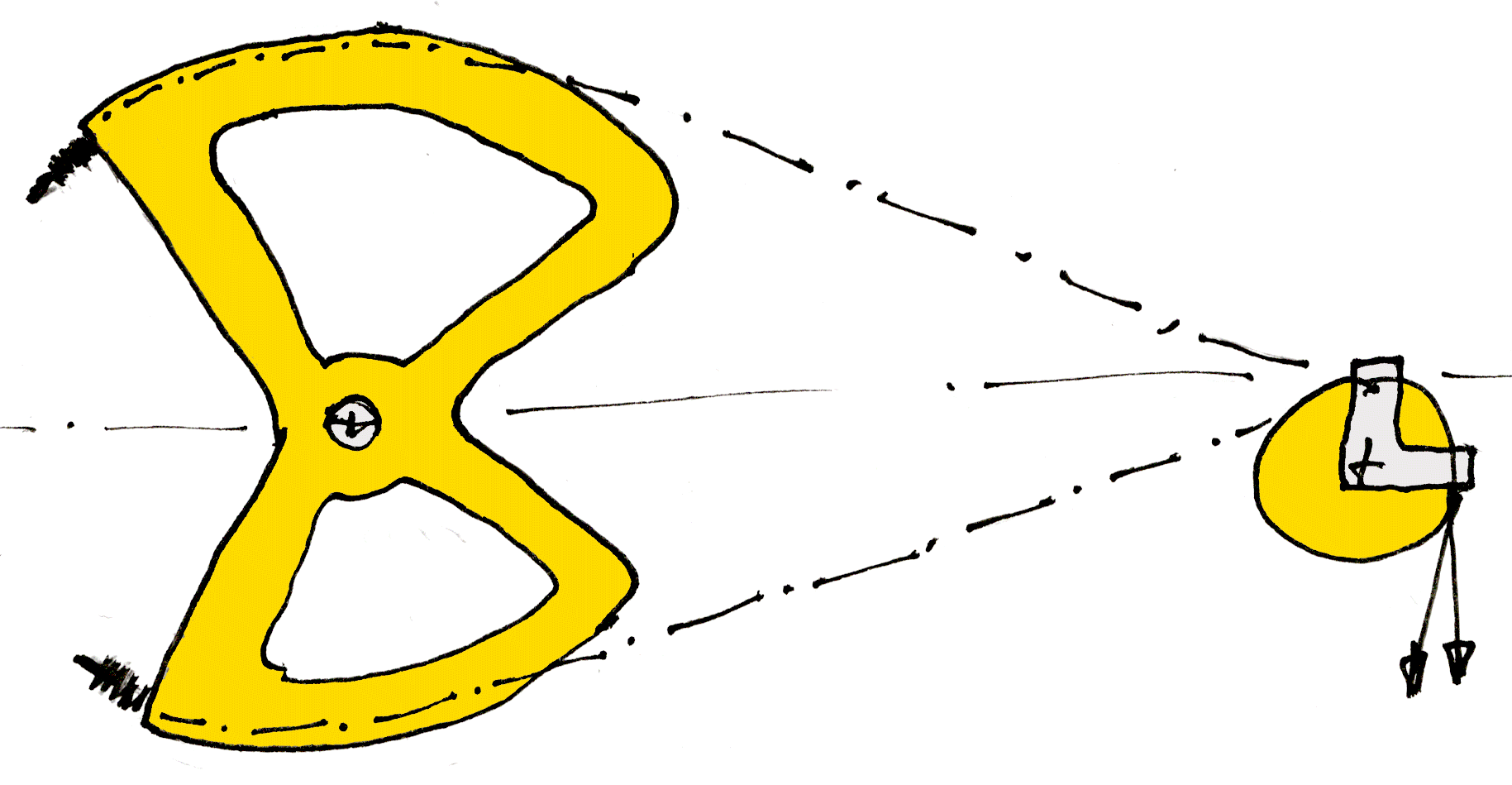
Figure 7.1 : Butterfly bellcrank ( cable end quadrant ) and pulley.
stiffness, mass and friction
Low structural weight, not necessarily low moving mass.
cable maintenance
Cables need considerable care and feeding. Already in manufacturing, their ends are difficult to anchor, even with soldered or swaged end balls. Cables ( even steel cables ) will keep stretching, especially under high loads. To maintain pretensioning, they will need frequent adjustment by threaded ends or bushings.
Slack cables will run off their pulleys, blocking the linkage, even if the absolutely necessary precaution has been taken to use fixed guard straps over every entry exit point and at 45° intervals between them, on each and every pulley. When visiting an aitcraft graveyard, the first thing that meets the eye are the control cables dangling from the cockpit.
Cables will fray with age, successively breaking wires. Their lives are limited, and unlike pushrods, they will fail sooner or later.
Truth be told, cables are a maintenance nightmare.
Instead of on a lever, one or both sides may end on a large pulley quadrant or on a winch drum.
XXXXXXXXXXXXXX More than 45° turns, and transmissions over successive pivots. Long travel for stiffness. Multi-turn winches ("capstan drives"). Awkward moment at the end effector,large quadrants. Not necessarily low mass, but probably low weight.
We will be referring here to cables running over pulleys. The special case of sheathed, push-pull Bowden cables will be only briefly discussed later.
band drives ( steel tape )
Higher stiffness, awful failure mode. Wind onto itself for winch drive.
7.4 Torque tubes
Some linkages may contain short sections of torque tube. We will see that torque tubes are far less desirable than push-pull tubes. This actually holds for torque in general, in any structure. But torque can sometimes give a simple solution over a short distance.
torisonal stiffness
Without going into the derivation, the torsional stiffness of a torque tube is as follows :
| (7.7) |
| (7.8) |
Using (4.14) to reflect the stifnesses, we can compare this to a linear stiffness at the end of a lever of length Rlever, similar to the length of the levers carrying the typical pushrod. This yields for the linear stiffness at the tip of the lever :
| (7.9) |
Comparing this to (7.2) for the pushrod suspended on the same lever, the torque tube is less stiff for two reasons : first, by the squared ratio of the tube radius to the lever radius, and second, by the ratio between G and E.
This can be seen without calculation : all the material is at a radius of R instead of Rlever, and the material is deformed in shear, not in tensile stress. XXXXXXXXXXXXXXXXXXXXX
numerical comparison between torque tube and a pushrod
For the example of the 20 x 1 mm aluminium tube that we used before, and a typical lever arm length of 50 mm, the tube used as a push rod is 5 * 5 * 2.5 = 62.5 times stiffer than the same tube used as a torque tube.
Viewed the other way, XXXXXXXXXXXXXXXXXXXXX
Same as a thin rod or cable of 1 mm, XXXXXXXXXXXXXXXXXXXXX
Remember the mass of a tube. Now make the comparison with a pushrod on a lever. Think of clear symbols for the radius of a tube and that of a lever. The mass turns at the tuibe radiusm instead of the lever radius. That's an R^2 ratio. Then show the reflected stiffness of a torque tube. Differs by G, but especially, it also differs by R^2. So the bandwidth is more or less the same, but at a very different scale relative to the pushrods, and realtive to the end efector. That's how you get to pushrods with the same diameter as the pushrod levers.
Solid torque shafts
For comparison we look at a solid torque shaft.
By comparison, it's a spring.
And from weight point of view, it's a disaster.
Solid torque shafts in a linkage (and probably in general) are an extremely bad idea.
7.4 Torque tubes on eccentric bearings
A torque tube does not need to be supported in its centerline. It can also make a pivoting, swinging motion on bearings located parallel to the centerline, outside the tube.
Eccentricity does not affect torsional stiffness,
because a torque has no point of application
We already had the polar mass moment of inertia (6.5) of the tube itself. If the tube turns on a bearing located on an arm of length Re away from the tube centerline, then Steiner's displacement theorem adds another term of m . Re 2 to the polar mass moment of inertia around the bearing :
| (7.10) |
An external bearing is always outside the radius R, so Re is always larger than R.
If Re ≅ 1.4 R, then this yields:
| (7.11) |
In conclusion, the eccentricity of the bearing makes no difference to the torsional stiffness, but it does increase the mass moment of inertia of the tube by a factor of approximately three. Whether this is a problem depends on the application.
7.6 Levers
Levers come in two varieties. Many levers, especially in pushrod mechanisms, only serve as lateral stiffness supports. They just shorten the unsupported length of the pushrods to counter buckling. These levers can be quite light, since they do not carry real forces. The mass moment of inertia of a lever (or a joystick) around a pivot point can be approximated by the standard equation for a straight stick :
| (7.12) |
The mass reflected to the output or other reference position is found by (XXXXXX). Together with the mass of the rod ends it may be on the same order as the mass of the pushrods themselves.
The second variety is the kind of lever which actually transmits a torque. These levers typically occur in pairs on the same pivot, often in the form of a butterfly or a bellcrank lever. They are used where the force changes direction, like in corners, or where pushrods and torque tubes interact. These levers deflect in bending. They also deflect the compliance of the pivot support, which we will treat later.
The stiffness of the lever is best measured as the linear displacement of the lever tip under an end force, while the base of the lever is blocked. See the sketch :
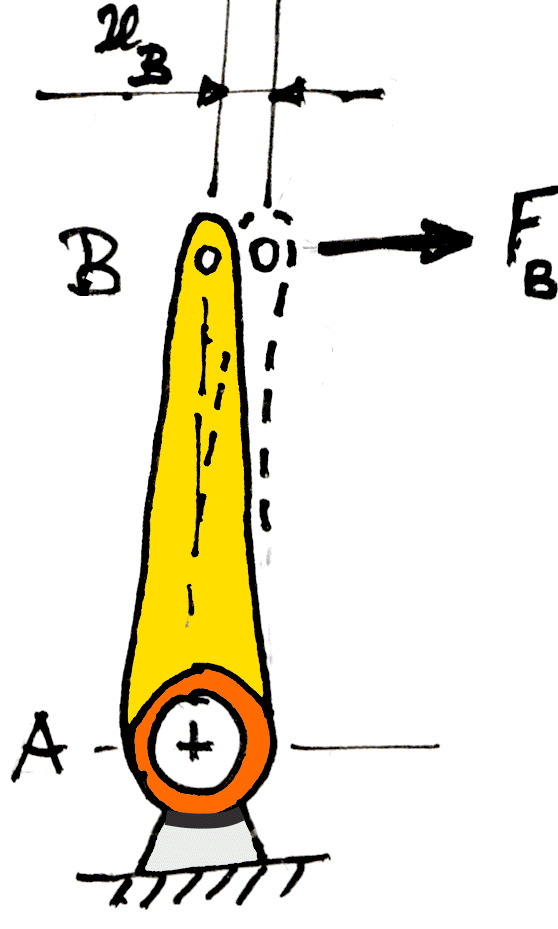
Figure 7.2 : Bending of a blocked lever.
If the lever is a prismatic beam of length AB, then the displacement of the beam tip under a side force is :
| (7.13) |
Most levers have a I-shaped cross-section, because this is easy to manufacgure and inspect, and there is normally no torsional load on the lever.
Since most of the displacement is due to bending near the root, it is usually sufficient to use the bending moment of inertia Ixx just above the root. The lever will then have an equivalent stiffness, similar to a short section of pushrod, of :
| (7.14) |
7.7 Support points
Support points are an often neglected source of compliance in linkages.
Figure 7.3 shows a pushrod chain actuated by a joystick. For simplicity, the end of the joystick is our reference location, and the lever arm for the pushrod on the joystick is the same R ≡ Rpushrod as in the rest of the pushrod chain, so the joystick has the same angular range as the pushrod levers, but this is not essential to the argument. The joystick loads the pushrod with a force F, short for Fpushrod, which is geared to the reference by a ratio of Rlever / R.
If the joystick is blocked, a pull force F on the outer pushrod
will compress the inner pushrod by a certain distance
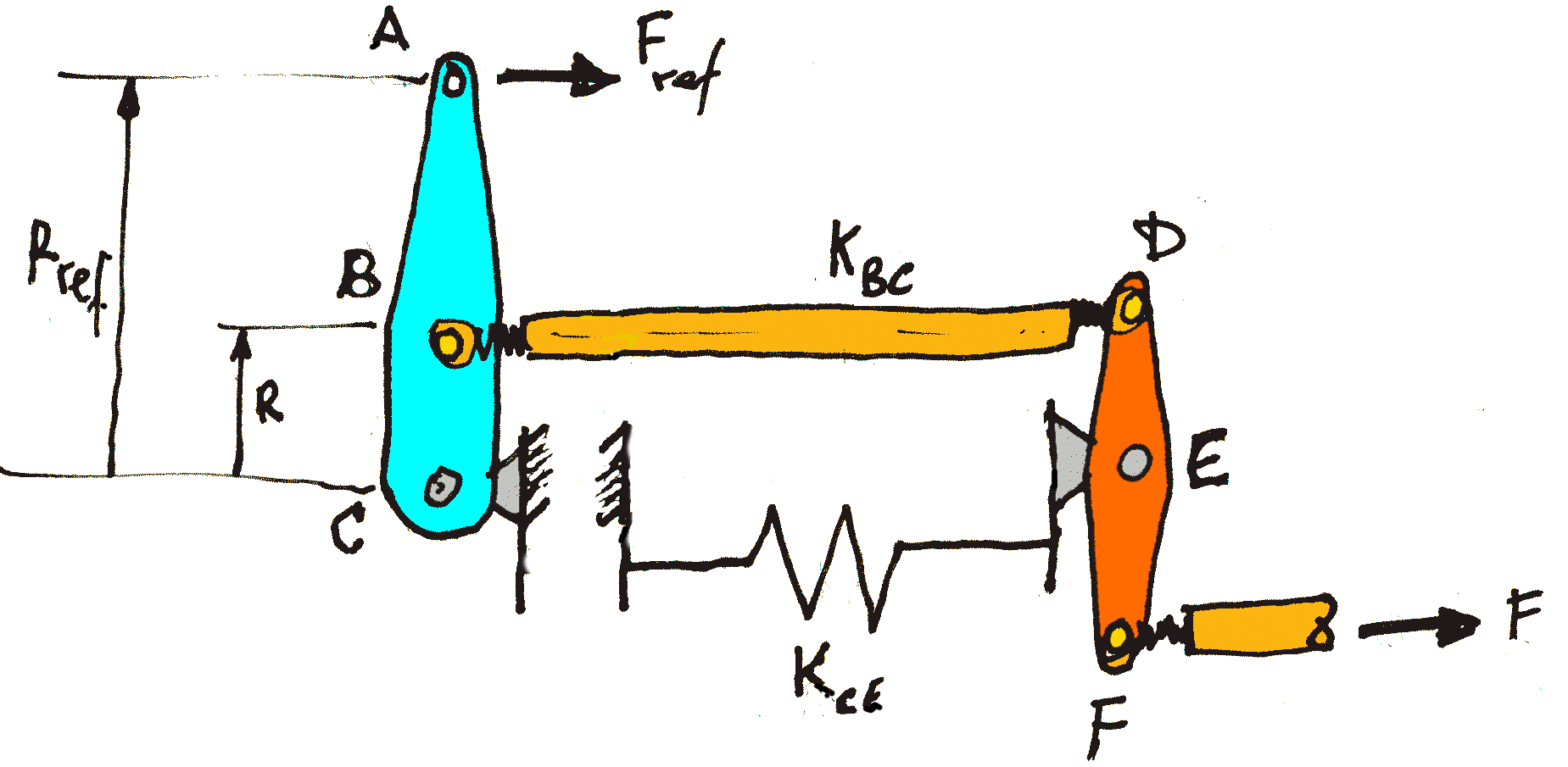
Figure 7.3 : Support compliance.
Now suppose that the frame between the "frame" fulcrums B and E is not infinitely stiff, but has a finite stiffness of KBE. Figure 7.4 gives a free body diagram showing the forces. The frame is stretched by a force 2 F. This will move point E to the right over a distance xE = 2 F / KBE. This will rotate the lever around point D over a further angle xE / R, and this will move point F to the right by a further distance xF = 2 xE.
The pushrod attached to F moves to the right four times more due to the stretching of the frame, than due to the compression of pushrod BC : first because the frame gets twice the force of the pushrod, and then because the point F moves twice as much as point E when the lever DF rotates around D.
This is not an unusual situation at all, and it shows that compliance in the frame is just as bad as compliance on the moving parts of the linkage, if not more so.
It is sometimes quipped that "the structure of an airplane is designed around the control linkage". That may be an exageration,but is is very important to route linkage components close to the stiffest parts of the supporting structure, preferaby placing pulleys and levers near the crossings of bulkheads, ribs and spars.
It may even be called for to add a dedicated stuctural shortcut between the linkage supports, like a static pushrod or tierod between pivot points like C and in the example. Such tierods do not move with the linkage, so their weight does not show up in the reflected inertia, although it does show up as structural weight.
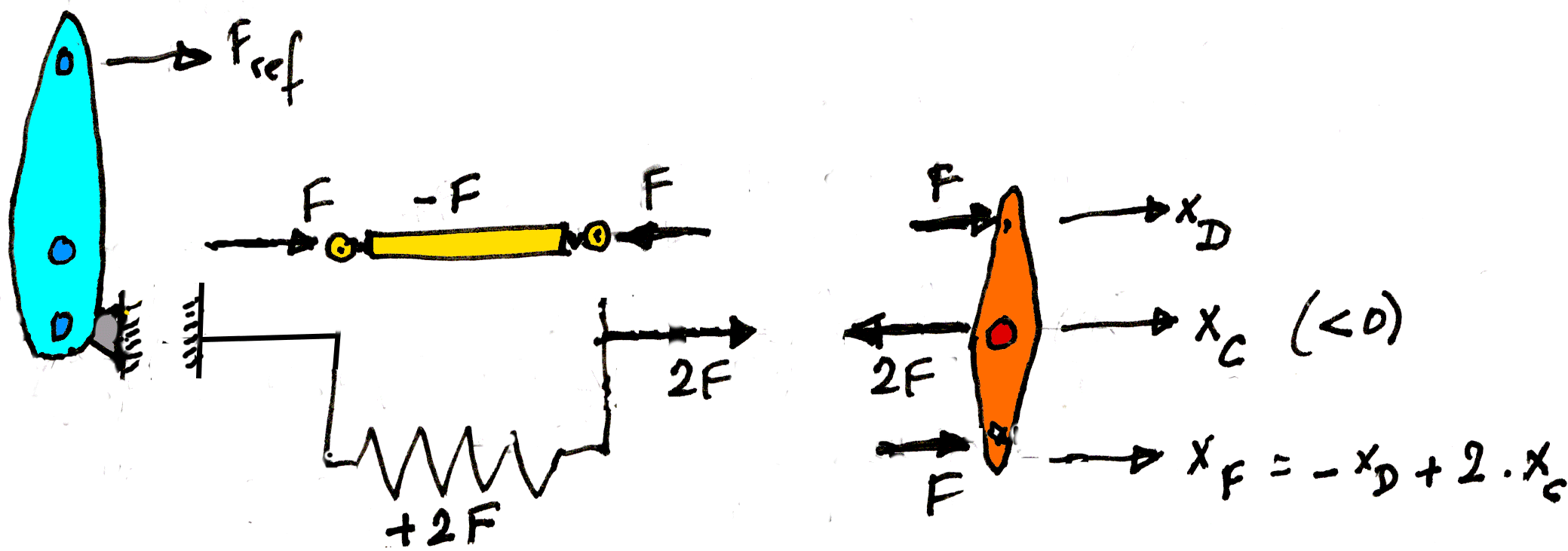
Figure 7.4 : Free body diagram.
The softness of a linkage chain is determined by its most compliant element. A single design flaw can ruin the bandwidth of the whole linkage. Levers should always have their frame pivot and their rod end in a single structural part, often a flat plate and sometiems an I-beam.
Figure 7.5 shows a classical design mistake. The lever is not mounted on a stiffly supported bearing, but halfway along a torque tube. The bending compliance of the torque tube will destroy any chance of a high bandwidth linkage.
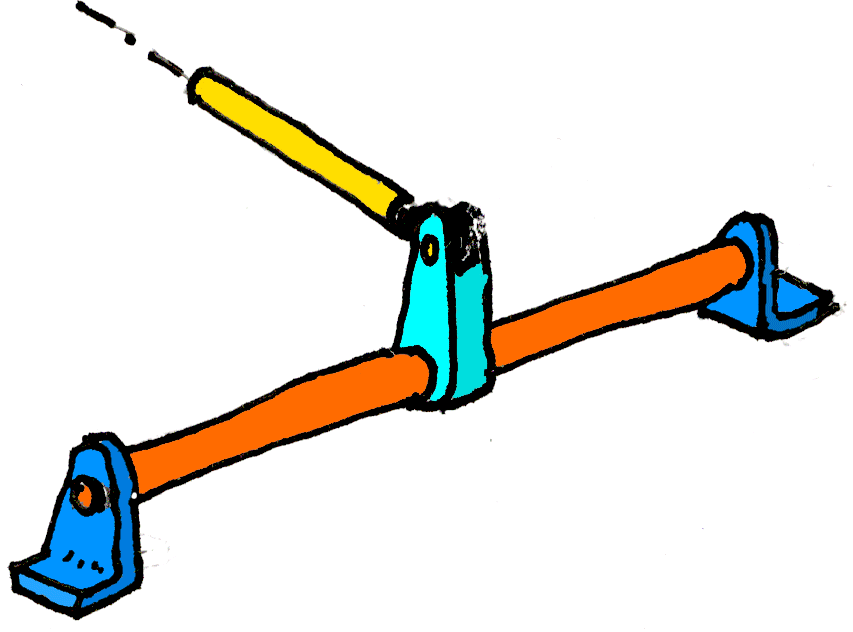
Figure 7.5 : Classical design mistake.
Pre-tensioned cable drives exert a constant force on the pulleys and their frame bearings, so they are less susceptible to variable support deformations.
7.8 Double pushrods
Pushrods are most often used as in Figures 7.3 : the linkage transfers a push-pull force along a single chain of pushrods. These pushrods are carried by levers, each pivoting on an stiff frame or on the fixed world.
The frame can be reinforced or even replaced by a structural shortcut, like a fixed tie rod between the fixed pivot points. This non-moving, extra strut will typically be made several times heavier and stiffer than the moving pushrod.
In some cases a different, more symmetrical setup can be useful, espcecially in a torque connection between two moving frames. Figure 7.1 shows a parallogram linkage similar to the one used to keep the protractor parallel in an old-fashioned drafting machine. The "free floating" coupler body is not anchored to the fixed world. It does not experience a net force, else it would accelerate. This means that the pairs of parallel pushrod carry equal, but opposite forces.
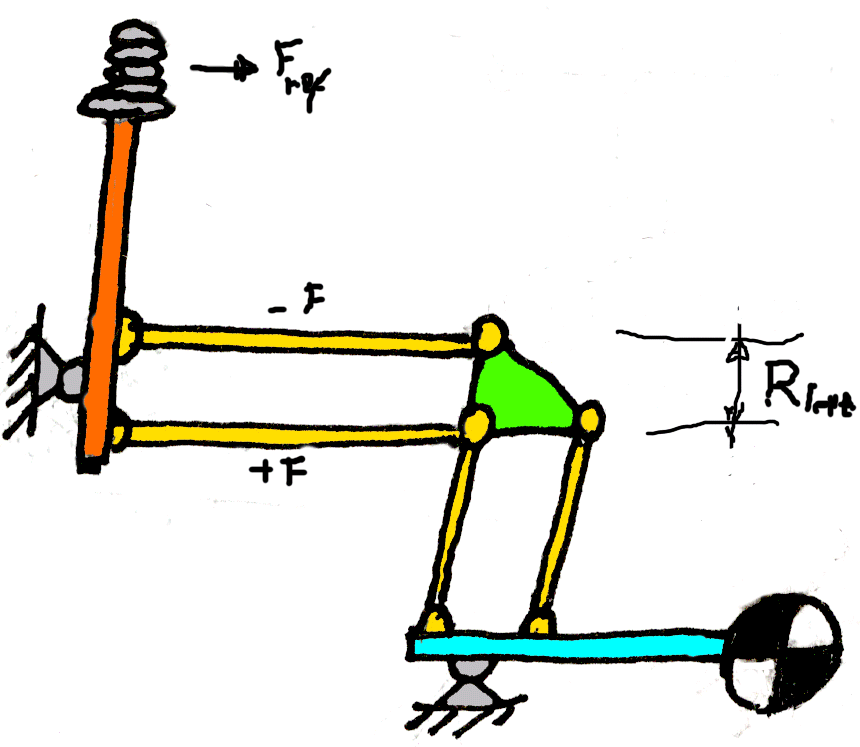
Figure 7.2 : Double pushrods.
We will first load the pushrods with the same force that they would have in a conventional layout with a lever arm of length Rlever. This happens when the two pushrods are a distance Rlever apart. They will each have a lever arm of ½ Rlever on the input side.
If we dimension the pushrods for strength, then the pushrods will have the same mass and stiffness as a single pushrod in the normal layout. Reflecting this to the same reference as before will give each pushrod a quarter of the mass and stiffness. Since there are now two pushrods, the reflected mass and stiffness of the the pair will be half that of the original single pushrod.
The original stiffness and mass can be restored by using pushrods of twice the stiffness and mass. This will increase the structural weight by a factor of four over a single pushrod : two pushrods, each twice the weight of a single one; but the dynamics will be the same. An alternative is to keep the size of the pushrods the same, and increase the lever arm.
This design can be used for torque transfer between two moving frames.
8 Mechanical components - strength and weight
8.1 Introduction
Linkages are typically designed for high stiffness and low friction, and to a lesser degree for low moving mass.
However, they also need to be checked for strength, and in some applications (like light aircraft) the structural weight (as opposed to the inertial mass) is a factor. We will run by a few common components to check on these aspects.
8.2 Pushrods
The tensile strength of a pushrod, and its compressive strength before buckling, is determined by the stress in the material σ :
| (8.1) |
Using the frontal area of a thin-walled tube from (6.1) yields :
| (8.2) |
As an example, using the allowable stresses (5.3) for a building grade aluminium tube of 20 x 1 mm gives an allowable push-pull force of 9,000 [ N ], or 900 [ kgf ]. Even with a modest lever "advantage" between a control stick and the pushrod levers, this well beyond the typical range for a light-duty hand linkage.
A pushrod in compression can buckle. The classic buckling equation due to Euler is :
| (8.3) |
For pivoting ends without directional clamping, the buckling length L is equal to the actual length of the pushrod, between the pivot points.
With Ixx for a thin-walled tube as in (6.3), we have :
| (8.4) |
The same 20 x 1 mm aluminium pushrod that we used as an example for the direct push-pull strength can withstand 2200 [ N ], or 210 [ kgf ] in buckling, at a length of 1 meter. This is fairly typical: pushrods are dimensioned for buckling.
Tell about inertial radius and slenderness.
8.3 Torque tubes
In a torque tube, the shear stress in the "outer fiber" of the material follows from:
| (8.5) |
Here, R is the outer radius where material is sheared. For a thin-walled circular tube, R is the outer radius of the tube, and Ip follows from (6.2). The torsional strength at a given allowable shear stress will be :
| (8.6) |
The allowable force at the end of a given lever arm will be :
| (8.7) |
Compared to the non-buckling strength (8.2) for a pushrod on the same lever arm, the strength of a torque tube is lower, first by the ratio between the tube radius and the lever arm, and then by the difference between the allowable shear stress and tensile stress of the material. The difference is not as disastrous as for the stiffnesses in (XXXX), but it is still easily a factor of 5 or 10 for practical values of R / Rlever.
The mass of the tube is:
| (8.7) |
The torsional strength per weight equals (56) divided by (57) :
| (8.8) |
Contrary to the pushrod, where the shape of the cross-section is irrelevant to the strength, a thin-walled torsion tube of a given strength and length becomes more weight efficient as the diameter increases. For equal weight, i.e. for equal R . t, the strength will increase if R increases and t decreases in equal measure.
The torsional stiffness per weight is:
| (8.9) |
In contrast to the pushrod, a torque tube of given stiffness therefore becomes lighter with the square of the diameter.
TBW.
The rotational mass moment of inertia is:
| (8.10) |
The ratio between the torsional stiffness and the moment of inertia of a torque tube is:
| (8.11) |
The bandwidth of an isolated torque tube is the square root of the stiffness divided by the inertia, here (64) divided by (63) :
| (8.12) |
The shear modulus G is approximately 0.4 times the linear stiffness or Young's modulus E. With the E of aluminium from (37) we have :
| (8.13) |
The square root of 0.4 is approximately 0.63. Relative to the pushrod (39), the bandwidth of the torque tube becomes:
| (8.14) |
Again, the number in itself does not mean much but it does provide a kind of upper limit. That limit is somewhat lower than for the pushrod, in a material properties ratio of √( G / E ).
In both cases, the bandwidth follows from a gearing ( in this case shear ) where the stiffness and the moving mass depend equally on the radius on which the material rotates. In the case of a pushrod, this radius is the length of the lever to which the pushrod is attached. In the case of the torque tube, the radius is that of the tube itself.
12 Bredt Batho
This is a special case of the more general Bredt Batho formula for the torsional stiffness of a box, or tube, of any arbitrary cross-sectional shape :
| (A.1) |
In this equation A is not
the frontal surface area of
the material, but instead the hollow frontal area
enclosed by the tube, which is then normally
referred to as a "torque box".
This is the way in which thin-walled aircraft wings
and fuselages get their torsional rigidity.
SAY SOMETHING ABOUT STAR SHAPES VERSUS CIRCLES, R^3
The length s is the circumference
of the hollow tube, measured along the outer wall.
Actually, if the value of G
and / or t varies along the circumference,
we need to take the integral of
∫ 1 / (G . t ) . ds
along the wall, and use the result
7.5 Torque tube numerical example
A torque tube should preferably have a larger diameter than a pushrod, but let us take as an example the same tube which we used before as a pushrod. This was a round alu tube of 20 x 1 mm with a length of 1 metre. We have :
Reflected by (27) to a point A by lever of 0.05 m, this is :
| (8.18) |
The same factor applies to the mass in A :
| (8.19) |
As a check, this gives for the bandwidth :
| (8.20) |
As predicted in (67), the bandwidth for the torque tube is less than that for the pushrod by a factor of √(G/E).This is a factor of around 0.6, which does not really change the order of magnitude for the bandwidth.
However, the stiffness and the moving mass are on a completely different scale than in the pushrod. For the same physical tube and lever, the reflected moving mass of the torque tube is a factor of 25 lower :
| (8.21) |
There is a shortcut to this ratio as well. The material, and therefore the stiffness and mass, of the pushrod rotates on the lever, at a radius of 0.05 [m]. The material of the torque tube however rotates on the tube's wall radius of 0.01 [m]. So, there is a difference in radius by a factor of 5, and the radius squared gets a factor of 25 :
For the stiffness, there is an additional material factor of
| (8.22) |
9 Flexible lines
9.1 Last resorts
TBW.
Bowden cables are a cheap and inferior solution. They have all the disadvantages of cable drives like continuous stretching, plus freeplay, plus massive friction.
Hydraulics on the other hand is not a cheap solution. It can be made to work well in some applications.
9.2 Passive hydraulics
We cannot leave the subject of hand linkages without briefly discussing hydraulics, and even low quality alternatives like Bowden cables.
The advantage of these solutions is that they can transfer forces across multiple intermediate moving pivots and joints without much thinking effort. These are complex and inferior solutions for lazy people.
But we are all lazy at times, and sometimes a quick and dirty solution is better than no solution at all.
bike and car brakes
Bicycle brakes area often actuated via by Bowden cables, but also by back-pedaling via the chain, by pushrod linkages, and by hydraulic lines. Car brakes area usually actuated by hydaulic lines as well. Travel is relatively limited, and forces are high.
9.2 Bowden cables
Hydraulics is soft and smooth, but not very stiff. And trust me, it always leaks.
10 Typical applications
10.1 Manual control of aircraft
The primary example of a hand linkage is in the manual control of conventional aircraft by "stick and rudder".
Most aircraft do not have power steering. The elevator, ailerons and rudder are controlled mechanically via a control stick and foot pedals. The transmission is via cross-stranded steel cables, over pulleys of approximately 80 mm in diameter, ending in a lever at the control surface.
A more expensive, higher-quality version uses lightweight pushrods. Each individual pushrod is less than 1 metre long to prevent buckling, and is supported by smooth-running levers of approximately 50 mm radius.
Changes in direction are negotiated by forked ( "butterfly" ) bellcranks. The places in the aircraft's structure where the pulleys and rockers exert a reaction force must be extremely rigid, to avoid losing energy from the linkage. They are usually located at the corners of a rigid spar and a rib or frame, so that they do not flex under varying control forces.
Manual aircraft controls of are extremely rigid, light and free of play, because the pilot must be able to feel the aerodynamic forces on the control surfaces directly. When the pilot releases the stick, the aerodynamic forces on the control surface itself must center the stick at the momentary equilibrium position.
Some airplanes are "stick-free unstable" as a whole, when the free elevator does not stabilize the airplane dunamically. Some even have a stick-free unstable elevator or "all-flying tail", where the elevator itself starts a wild diverging oscillation when the stick is not held.
10.2 Flight simulators ("control loading")
Mention artifical feel as well ?
5.3 Haptics
Haptic means "related to the sense of touch". It is the scientific term for what used to be called "force feedback". The field developed in the 1980's out of the "artifical feel" or "control loading" for flight simulator sticks, but it is now also taken to include tactile feedback.
11 An application in MRI
11.1 A haptic joystick in MRI
The direct motivation for this section on hand linkages is the design of a haptic joystick for use in MRI. By "haptic" we mean a computer-controlled, force-sensitive so-called "manipulandum", capable of operating close to the bore of the MRI tunnel.
Many machines of this type have been built over the years, but they do not seem to be very successful. Or maybe the world does not really need them, but we will leave that possibility aside for now.
Most solutions focus on finding actuators and force sensors that are allowed in the MRI room. This leads to aluminium induction motors, active hydraulics, etc. Another solution, rarely seen, is to perform the actuation and measurement outside the MRI room, and transfer the movement to the MRI table using a simple, passive mechanism. The reason this road is rarely taken is probably the perception that it will be very hard transfer hand movement rigidly, lightly and with negligible friction over the required distance of almost 10 metres.
Yet there are plenty of examples of this in other fields.
The forces and distances from the control stick to the control surface are of the same order as those in an MRI chamber, and sometimes longer.
Large commercial aircraft from the 1950s, including the first generation of jet transports, still had manual controls. It should therefore be possible to apply this principle to transfer the movements of a haptic drive from outside the MRI chamber to a manipulandum close to the MRI tunnel. The only difference with an aircraft is that no metal parts are allowed.
An added complication is that the bed slides back and forth during use, but this problem is no larger than in an aircraft with folding wings.
requirements on the mechanism
The linkage system should be light and rigid, and as free as possible from play and friction. This note is an attempt to examine these properties and optimize them where possible.
TODO
- angles over 40°, undercarriages, vulgraad.
- control loading, force sensor at motor, instability of chains with the FS at the EE.
- this is a good reason for lightweight,low friction linkages.
- hard master, soft slave (cross-ref to master-slave).
- refer to soft control in general (gentle,stable, robust),
like in the VLT delay line and the ISO satellite RWS control.
- integrate, don't differentiate. Velocity, not position. Cascaded control.
- end stops at the input side ( panic forces ).
- cable "mechanism", not drive ?
- cable drives first, a/c, Sensable.
- pre-tensioned tables are "push-pull". Slack is bad, derails too.
- stiffness of ( pulley ) supports - place with cable chapter ?
- parallel versus serial.
- MRI elsewhere.
- lever.m code.
- keep pushrod at right angles to lever ( don't aim at lever pivot ).
- Galloway mechanism.