Trim drag is the drag penalty incurred when "trimming" an airplane for a stable flight condition.
Trim drag is frequently the subject of "inventions" and "optimizations" which drive entire airplane concepts. This is usually totally unjustified, and often leads to wrong design decisions, in particular the "canard " and the "tailless" aircraft concepts. We will first discuss the trim problem itself before getting back to the related drag penalty, if any.
Trim is the equilibrium condition where the total pitching moment of the airplane is zero. This is a necessary condition for steady flight, but it is not enough.
To be useful, the trimmed condition also needs to be stable. We will discuss this elsewhere. Briefly, the airplane needs to act like a weathervane, with the center of its "side area" aft of the pivot. In free flight, the CG is the pivot. The center of the side area is called the AC ("aerodynamic center").
I always had an uneasy feeling about trim and the elevator.
It is a well known fact that the tailplane download increases with airspeed, and that in many airplanes the tailplane load is upward in slower flight. I believed this to be due to the higher angle of attack.
But there is a contradiction. To get to slower flight, you have to pull up elevator. And this gives a down force on the tailplane, not an up force. It seemed like two forces were fighting, and the winner was not clear to me.
Friends of mine were trying to balance a canard airplane, and this gave me a reason to finally think this through. I found that in most standard textbooks the answer to the static equilibrium is rather hidden in the analysis of the dynamic stability. The section below gives a clean and simple shortcut to the static solution.
It turns out that the up or down load on the tailplane or canard consists of two independent components.
One component of the tail load is purely aerodynamic. This component is needed to balance the intrinsic nose down moment that every curved wing section exerts on the airplane. This nose down moment is a constant in the non-dimensional world, and so dimensionally it is proportional to the square of the airspeed. The down force on the tailplane needed to counter this moment, is therefore also proportional to the square of the airspeed. This download always wins in the end, for the higher airspeeds.
The other component is also aerodynamic of course, but there is a simple shortcut to it : for the trimmed condition, it is simply the static force balance around the aircraft CG between the lift of the wing and the lift of the tailplane. Since these are at fixed distances from the CG, this balance is independent of the airspeed. For a given aircraft weight and CG, this component of the tailplane load is therefore, somewhat surprisingly, fixed.
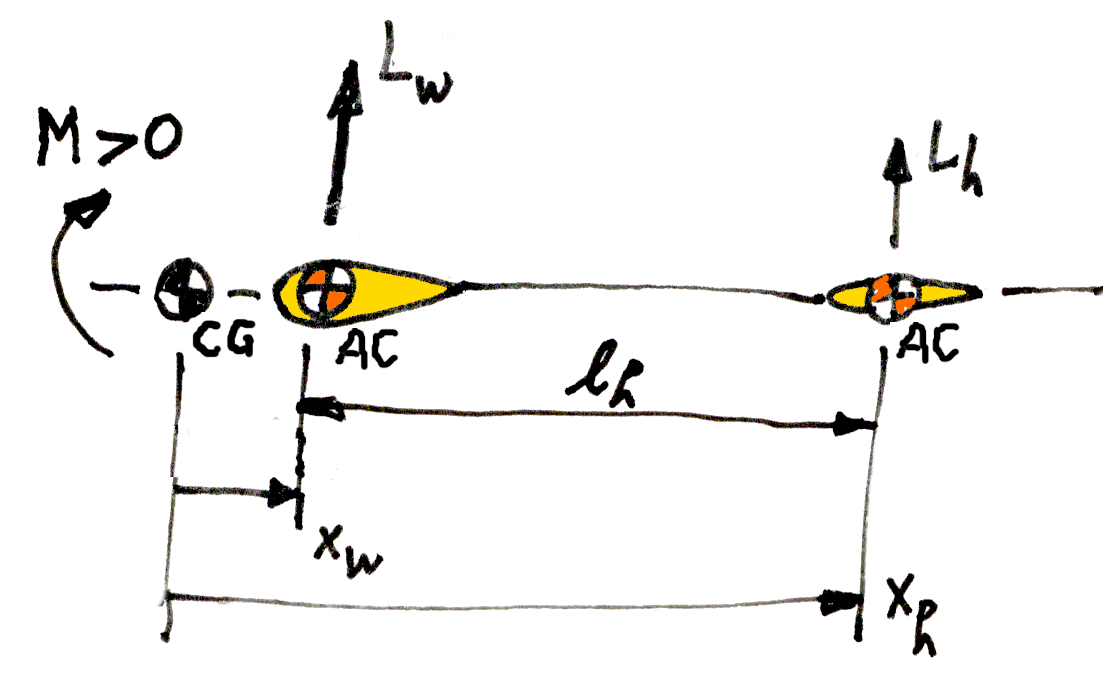
Figure 1 gives the sign conventions which we will use in the equations. Note the arrangement does not necessarily represent the actual signs in every case. For instance, in an actual aircraft, the wing AC may well be forward of the aircraft CG, so xw may well be negative. And in a canard the "horizontal stabilizer" will always be ahead of the CG, so xh will always be negative.
Figure 1 : Trim sign convention
A normal, downward curved wing section gives a nose-down moment at zero lift. To compensate for this towards equilibrium, we need to add a positive ( nose up ) moment. This is normally provided by a stabilizer pushing down or a canard pushing up. The wing needs to give the opposite force to maintain net zero lift.
This is accomplished by a difference in angle of attack, hence in lift coefficient, between the wing and the stabilizer. Typically the wing rotates a little bit up, and the tailplane a lot more down to maintain net zero lift, because of their difference in area. The difference in incidence is officially called "decalage", with a nice 1914 vintage French word.
We can make a quick estimate of the lift coefficient needed on the tailplane. We take moments around the CG at zero lift. With an x coordinate defined as positive aft, the wing lift and the tailplane lift give a nose down moment for positive x. The non-dimensional zero lift moment of the airplane is called Cmac . It is due mostly to the curvature of the wing, and it is always negative. The total moment in equilibrium must be zero :
| (1) |
We define :
| (2) |
For zero lift we have :
| (3) |
This turns (1) into :
| (4) |
This result could also have been found by taking moments around the wing AC, which is allowed in the zero lift case, but taking moments around the CG avoids the discussion, and extends more naturally to the later case including a net lift.
Since Cmac is always negative, we see that this component of the tailplane lift is always down, and it is proportional to the square of the velocity. The equations are identical for the canard aircraft, with the only difference that lh is negative for the canard, and so the canard lift is directed up.
We can write the Lh in (4)
in non-dimensional form with
the definition of a tail lift coefficient
or CLh.
Leaving out the common term of
| (5) |
which means :
| (6) |
The fraction on the right hand side is the inverse of the so-called "tail volume coefficient" ( so called because of its dimension of a length times an area ). Typical values are Sh / S = 0.2 and l h / c = 2.5, and so the tail volume coefficient is on the order of 0.5. A typical value for the Cmac of a conventional NACA airfoil is − 0.10.
Such typical values lead to :
| (7) |
The wing lift is even simpler. Taking moments around the tailplane AC, or working through (3) and (4), or simply by stating that for opposite lift ΔCL . S = − ΔCLh . Sh we have :
| (8) |
The wing needs a small positive
ΔCL,
and the stabilizer needs a larger negative
ΔCLh.
From first principles
It must be noted that this is the decalage between the zero lift directions of the wing and tailplane sections, not some arbitrary geometrical "zero" direction.
A common value in model aircraft is − 3°, and this makes sense if we take into account the effect of the downwash of the wing on the tailplane. This reduces the aerodynamic angle of attack of the tailplane with increasing wing lift, leading to a lower effective value for dCLh / dα. We will not go into this, because here we are only concerned with the principle and the first order of magnitude of the decalage, not its exact value in a particular case.
The negative ΔCLh explains why stabilizers often have "inverted" wing sections, although we will see that there is another factor which contributes to the tail load.
In a canard, the equations are the same, but the sign of l h is negative, since the canard is ahead of the wing. Also, a canard is not in the downwash of the main wing, so it may need a decalage of only + 2°. However, we will see that the other, "fixed" term in the canard is much larger than in conventional aircraft.
The analysis so far has produced the following result. With the decalage set to the proper value, we have :
- an airframe with zero moment and zero lift at any speed.
This airplane is in every way identical to an airplane with a symmetrical wing section and a symmetrical tailplane section at zero incidence, except for one thing : in the actual airplane, there are constant Δ CL offsets on the wing and the tailplane. These constant CL offsets create a down force on the tailplane which is proportional to the airspeed squared, and an equal up force offset on the main wing, together always giving zero lift.
It is interesting to note that all relations so far are independent of the aircraft weight and of its CG location. These simply do not appear in the equations.
We will now add a net lift to this neutral airplane. This will introduce the CG into the mix.
We now add a net lift, but we keep a zero moment, because we are looking for the static, trimmed condition. The moment is defined around the CG location, because the net lift needs to apply there, and so we will not have the net lift in the moment equations.
The total lift L is provided by the wing lift Lw and the stabilizer lift Lh :
| (9) |
We define new lift terms needed at the wing and the stabilizer to create this net lift L, without disturbing the zero moment balance of (1) and (2). We will call these new lift terms Lw+ and Lh+ :
| (10) |
With (3) this simplifies to :
| (11) |
Similarly, we expand the trim equilibrium moment equation (1) with the new terms :
| (12) |
Subtracting the orginal (1) simplifies this to the more or less obvious result :
| (13) |
Equations (9) and (13) describe a classical beam balance ( easiest to see if xw < 0, so the CG lies between the wing and the tailplane ), with the following algebraic solution ( where l h was defined in (2) ) :
| (14) |
| (15) |
These forces are independent of the flying speed. They are simply a force balance around the CG location.
This is the reverse case from Δ Lh and Δ Lw of (3) and (4), which trim out Cmac . Those forces are proportional to the square of the flying speed, but they do not vary with the CG location.
Figure 2 shows how this works out in a typical conventional airplane, and in a canard.
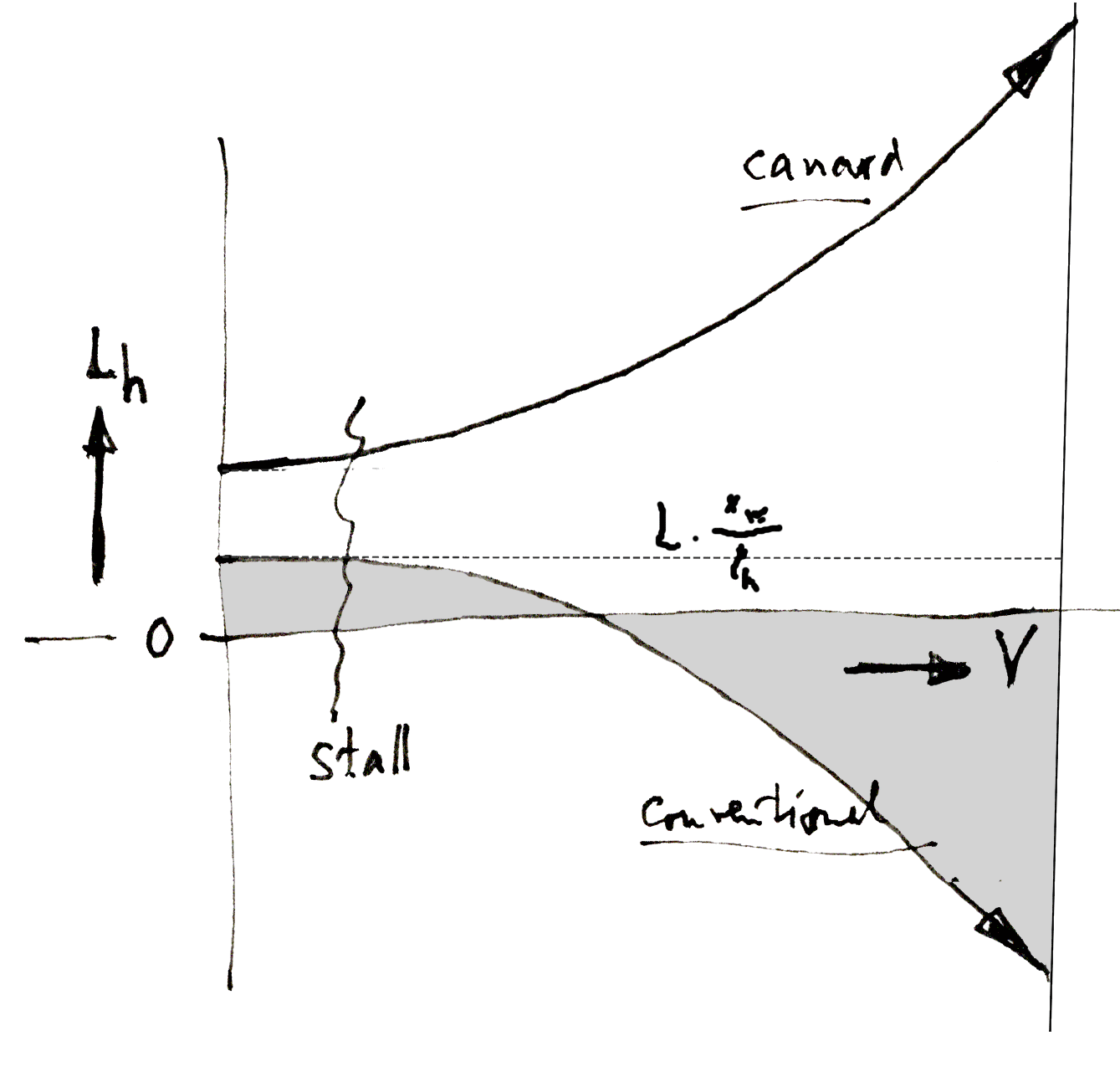
Figure 2 : Stabilizer load with flying speed
In a conventional airplane, the CG may be ahead of the wing or behind it. We will study this below.
If it is behind, then the trimmed tailplane load starts out positive at "zero speed". If the CG is at the wing AC, the tailplane load starts from Lh = 0. If the CG is ahead of the wing AC, the tailplane load starts out negative. In all cases, the trimmed tailplane load goes negative at high speeds.
In the canard, the CG is always ahead of the main wing. The canard load starts out positive from "zero" speed. With increasing speed, the canard load becomes ever more positive.
From equation (14) and Figure 2 we see that it is interesting to know if the CG lies ahead of the wing or behind it, and if so by how much. With the typical numbers used in (6) and one more rule of thumb, we can hazard a guess.
For the static and dynamic stability, the most important
point in the aircraft is the overall AC
To a first approximation, this is a fixed point in the aircraft. It is not the same as the CP ( center of pressure ) : we are talking about the change in lift with angle of attack, not the location of the actual lift. From the discusson of Cmac it should be clear that these points are not the same.
The AC of the whole airframe is the weighted sum of the AC's of all the aircraft's components, including wing, tail and fuselage. In practice, the wing and the taiplane are the major contributors. To a first approximation, we can find the location of the aircraft AC by taking their average, weighted by their surface area :
| (16) |
We want to know how far the aircraft AC is is behind the wing AC. Doing the subtraction, collecting terms, and using (2) for the definition of l h we have :
| (17) |
This should not surprise us too much. It is just the weighted distance between the tailplane and wing AC's.
We will need this distance in terms of the average wing chord, or MAC ( mean average chord ). This is :
| (18) |
With the numerical values used before in (6), we have :
| (19) |
We now take into account a stability figure of merit called the "static margin". This is the ( non-dimensional ) distance between the aircraft AC and CG.
The aircraft will be stable like a weathervane,
provided the effective location of the weathervane's side area
| (20) |
Simple arithmetic gives :
| (21) |
A healthy static margin is typically at least 0.1 or 0.2 c. If we select 0.2 for a reasonably stable airplane, with still a bit of leeway for aft CG locations, then we have, from (19) in (21) :
| (22) |
In words, the aircraft AC lies about 0.4 c aft of the wing, and the aircraft CG lies about 0.2 c forward of the aircraft AC, so the CG lies about 0.2 c aft of the wing. The CG lies between the wing and the tailplane, so the tailplane wil have positive lift at "zero airspeed".
Applying this to (14) we have for the tailplane load :
| (23) |
With xh = lh + xw from (2) we have from (15) for the wing load, as a check :
| (24) |
Sure enough, (23) and (24) together provide the overall lift L. Figure 2 gives the correct view in this case : the tailplane load starts out positive, and then becomes negative beyond a certain airspeed.
In practice, many other parts of the aircraft such as the fuselage nose and the engine nacelles tend to be destabilizing. They tend to move the overall AC forward. This is not a problem if we move the CG forward by the same amount. Model aircraft for instance usually have the CG at the wing quarter chord point.
We repeat the numerical example for the case of the canard. The equations and the sign conventions are the same, but some numerical values have reversed sign. Figure 3 shows some definitions.
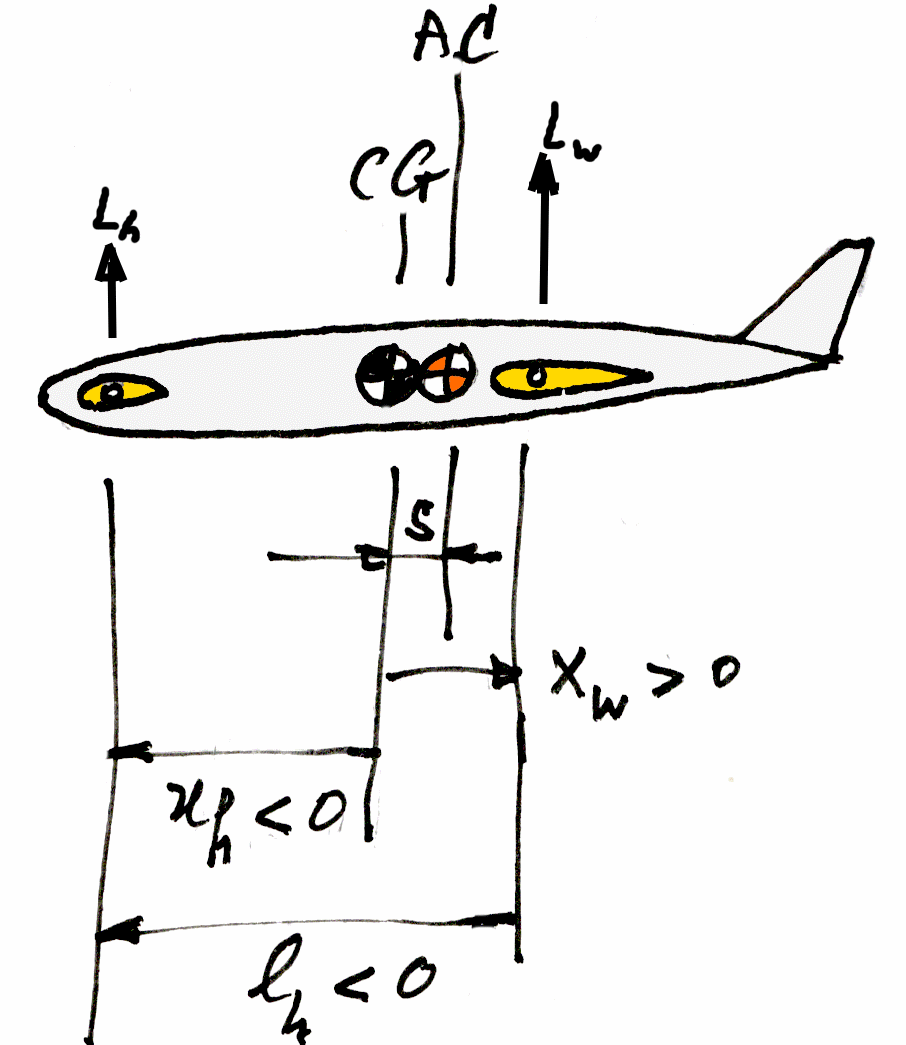
Figure 3 : Canard geometry.
The absolute value of 2.5 for lh may still be about right, but the sign is now negative, for the stabilizer is ahead of the main wing.
| (25) |
With the same ballpark figure for for Sh / S, (19) now becomes :
| (26) |
and with the same static margin s = 0.2, (21) becomes :
| (27) |
In words, a stable CG will lie well ahead of the main wing, because the aircraft AC lies ahead of the wing, and the CG lies ahead of the aircraft AC. With the wing AC always at the wing quarter chord point, the CG typically lies 0.35 c ahead of the wing leading edge.
Applying this to the trim equation (14), where xw and xw were relative to the CG, we have :
| (28) |
As a check, with xh = l h + xw from (2) and with the negative l h from (23), the main wing load (15) becomes :
| (29) |
The overall lift is still L, but the canard carries a far greater part of the load than with the normal stabilizer, even at "zero speed". As we saw in Figure 2, this load only increases with higher airspeed.
This sometimes leads to elaborate high lift devices on the canard, which makes one wonder if it is a good idea to make such a small surface responsible for such a large part of the overall lift.
Trim drag is the name for the performance penalty we have to pay for trimming an aircraft to zero net moment, relative to the ideal of a single wing, preferably with elliptical loading, doing all the heavy lifting.
There is a folklore that strongly ( aft ) curved wing sections with high Cmac and forward CG positions cause large negative tailplane loads, and that large negative tailplane loads cause large induced drag contributions.
This even leads some people to believe in the superiority of the canard layout. In the cold light of day, I believe these are all fairy tales. But perhaps someone can direct me to an analysis which shows otherwise.
- difference between static and dynamic elevator effect.
- a trim step input gives a dynamic response of the "weathervane" around the CG.
- extreme forward CG necessitated upside-down slot in stabilizer.
- F27 mild upside-down stab section,