VORTEX THEORY
The previous chapter introduce the discrete spiral horseshoe vortex, but for calculation it assumed that the spirals were "infinitely" tighly wound. We now turn to the case of finite blade spacing. Before we move to the actual spirals, we look briefly at another simplified model.
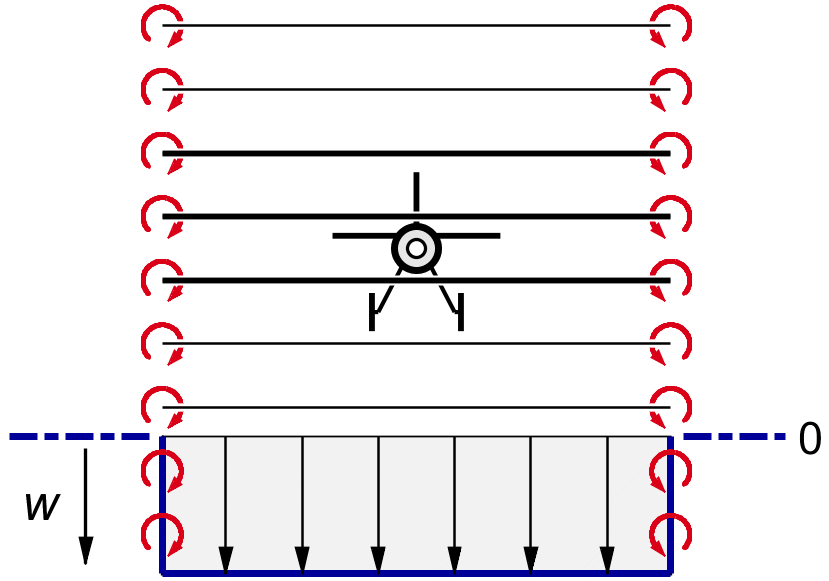
The propeller is in some ways similar to an infinite multiplane wing. Figure 24.1 shows such a multiplane, with a small but finite spacing between the wings. It is reminiscent of the early "Venetian blind" multiplanes of Horatio Phillips, although he had to stop at 120 decks for practical reasons.
Figure 24.1 : The downwash of an infinite multiplane wing.
The tip vortices in the two vertical tip planes form two side walls, which separate the region of uniform downwash between them, from the region of zero downwash outside. There is a direct parallel with the almost uniform axial induction inside the windings of a solenoid, and the zero induction outside, but the math of the flat vortex wall is much simpler for the case where the blade tips have finite spacing.
We will not do the math here, but the outcome for finite spacing is that the downwash over most of the wing is basically a constant, but at the tips there is a transitional region with a sharp down and up vortex, like in the finite wing tip of figure 23.4. Setting the constraint of uniform downwash across the span gives a flat inner region for the lift, and a nearly elliptical tip.
The shape is very similar to Prandtl's tip function of figure 21.6. XXXXXXXXXXXXXXXXXXX This is not surprising, since Prandtl's tip came from the flat plate model of figure 21.1, XXXXXXXXXXXX which is similar to the left or right half of an infinite multiplane wing.
A physical propeller will not have zero spacing between the spirals. It will therefore not have the sharp step in the axial induction from a uniform value inside a region, to zero outside it, like in the ideal solenoid, or in the ideal multiplane wing.
By Prandtl's approximation, we are used to the idea that with finite tip spacing there will be tip loss, and that the optimal tip shape will have a family likeness to the elliptical tip of an optimal wing.
Attempts were made quite early to find the optimal lift distribution for the propeller from the horseshoe spiral vortex model. However, the math for the spiral vortices proved harder than that for the straight line tip vortices of the wing. The axial induction from the spirals contains modified ellipse terms, which are notoriously hard to integrate.
In the 1930's, Goldstein and others published the equations, but before the age of digital computers these were too tedious for everyday use.
Prandtl's tip approximation remained the option of choice in all design texts.
In the 1950's, the German ship propulsion engineer Lerbs published a very good approximate solution of Goldstein 's equations.
These equations were still complex for hand calculations, but more amenable to computer use. Wrench made a slight improvement to the approximation and published a set of tables, more detailed but otherwise identical to Goldstein's. Still being tables, they did not replace the Prandtl tip function in preliminary design for quite some time.
However, Lerbs's and Wrench's equations are simple for present day laptop computers. Elsewhere in this website you will find simple Matlab © code which runs the whole calculation in a fraction of a second.
We do not give a justification of Lerbs 's equation. The story leading up to it would require a separate volume, But we will give a feeling for its shape. Lerbs 's equation is the direct equivalent of the wing tip vortex downwash (21..6), but this time for the tip spiral, starting with the axial propwash from a single tip spiral, and then combining the B nested spirals of a propeller with B blades.
Lerbs gave the axial induction on the blade lifting line from B coaxial spiral vortices, where B is the number of blades as usual. To be precise, his equation gives the axial velocity dv induced on the lifting line at a radius xw, by the B spiral vortices of combined strength dΓ at the radius xt.
This is the direct equivalent of (21..6) for a single trailing vortex trailing from the wing, except it gives the induction dv at the lifting line, instead of dw in the far wake :
| (24.1) |
In what follows, we will use the induction win the far wake. From symmetry, this is exactly twice the value v at the disk plane in the propeller plane. We multiply by 2.
At the same time we prepare for a fully non-dimensional expression by dividing by V, and multiplying the right hand side top and bottom by R :
| (24.2) |
The radius coordinates xw and xt are already non-dimensional in Lerbs, by the same definition of x = Ω r / V taht we are using since (2.10). This gives Lerbs's equation for Z the information it needs on the spiral angle φ of the trailing vortex at xt. Applying the Γ ′ definition of (23.5) makes Lerbs's equation fully non-dimensional :
| (24.3) |
The role of the tip speed ratio X was already discussed in (23.12).
The function Z ( xt, xw, B ) describes the transition between the region of uniform induction inside the trailing spirals, and of zero induction outside it. Its value is non-dimensional. The basic value of the gain Z inside the spiral is 1, and the basic value outside it is zero. In between, the value of Z describes the up and down sweep of the induction as xw passes the trailing vortex.
Figure 24.2 shows the value of Z for a two bladed propeller, at a radius of X = 3.5, which would be the ring at a typical 0.7R for a propeller of a typical tip speed ratio X = 5.
TODO Discuss band of 2π/B à la Prandtl.
Having said that, the tip speed ratio is irrelevant to the action of any ring inside it.
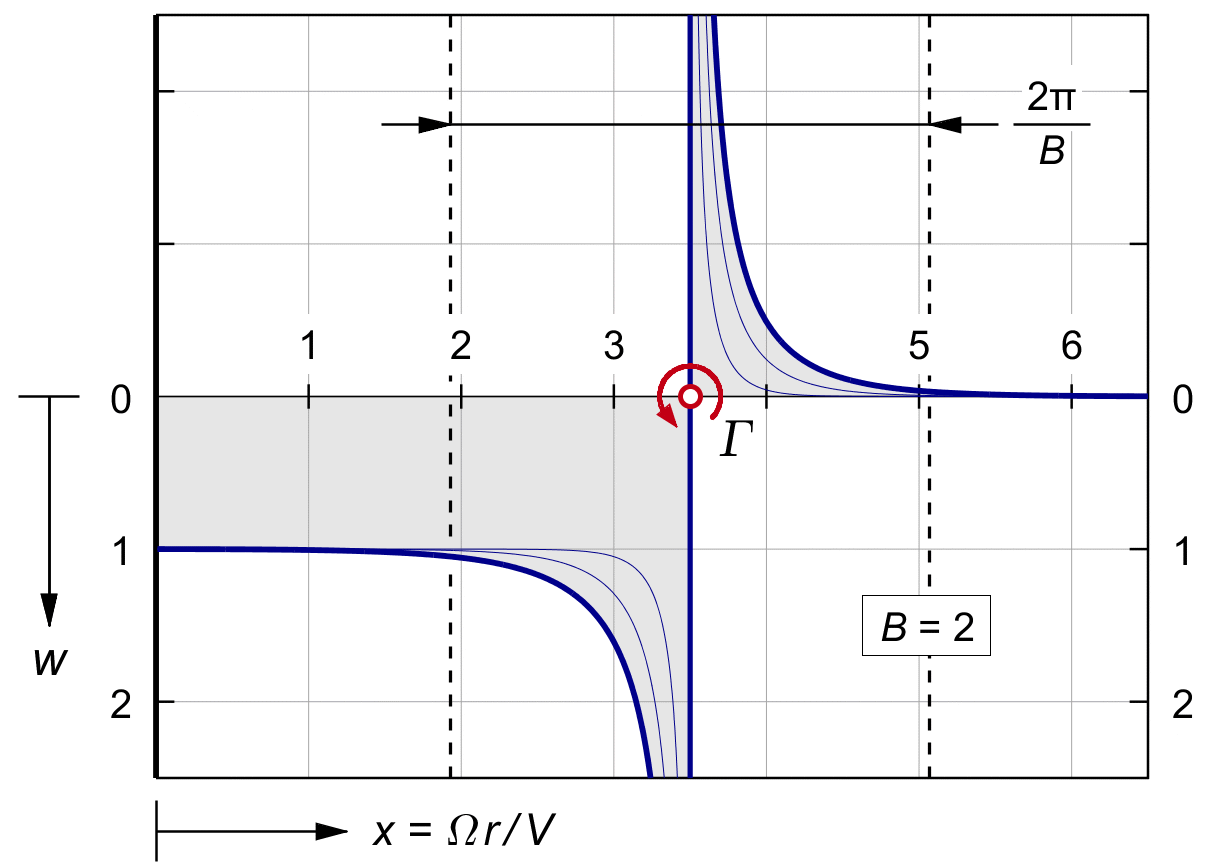
Figure 24.2 : Lerbs's axial induction in x, from B spiral vortices.
Like in Prandtl's approximation, the effects of B and those of x are very similar. Both act on the axial spacing between successive spirals, though in a geometrically slightly different way.
When the spiral location is further out from the propeller axis, the transition occupies a smaller part of the blade length, and the induction factor inside the spiral becomes closer to a flat value of 1.
This is an essential difference with the induction of the straight line vortex in the wing, which has zero tails to both center and tip. The function Z is in fact more closely related to the multiplane wing of figure 24.1, which also has a uniform inner region.
We now use Lerbs's downwash equation in a discrete lifting line theory for the propeller, in exactly the same way as we did before for the wing.
We will use in the propeller the same half circle distribution of discrete vortices that we used in the wing.
This is not immediately obvious, since the baseline thrust distribution in the propeller is not an ellipse. A quarter circle cosine distribution works almost as well here, and neither solution is exact.
It is even tempting to thin kthat the core vortex is not a "true" tip vortex, since it does not induce any axial induction, only rotation, but that is a bit too rash.
Failing a simple shape for the optimal lift distribution in the propeller, we stick to the half circle from core to tip. By good fortune, we find that it gives nearly perfect results.
Figure 24.3 is the equivalent for the propeller, of figure 22.3 for the wing. Unlike the xx range in the wing which is symmetrical around&nbdp;0, with x = Ω r / V the x coordinate in the propeller runs from 0 to X. The equivalent of (22.3) and (22.4) is :
| (24.4) |
| (24.5) |
This places the first and the last trailing vortex at the tip ( xt = X ), c.q. at the core ( xt = 0 ).
Likewise, the equivalent of (22.5) and (22.6) is :
| (24.6) |
| (24.7) |
This places the downwash ( and bound vortex ) control points halfway between the trailing vortex radius points, giving N control points between N+1 traling vortices.
The ordering of the points is from the tip at x = X, to the root at x = 0. This "reverse" order makes no difference to the equations, and it allows us later to build up the bound vortex starting from a guaranteed value of zero at the free tip end.
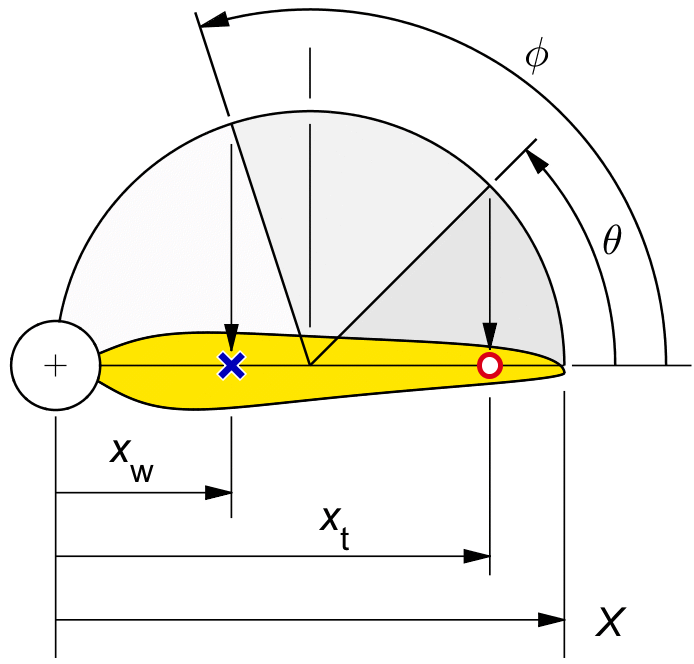
Figure 24.2 : Full cosine distribution in the propeller.
Like in (22.5) for the wing we can put the transfer from the trailing vortex radius terms to the downwash radius terms into an influence matrix A :
Define the step from (24.1..3) to A
| (24.8) |
Similar to (22.7), the transfer from the trailing vortices to the axial induction values in between them is :
| (24.9) |
Like in (22.10), the reverse path is :
| (24.10) |
The basic matrix A has the dimensions (N+1) x N. There are (N+1) trailing vortices dΓ for N downwash locations.
We can call the condition (22.8) on the total trailing vorticity to the rescue again to increase A to (N+1) x (N+1) before inverting it.
However, in the propeller we have the immediate alternative of reducing the order of A to N x N before inverting it, by leaving out the last column. This column contains only zeros. It gives the axial influence of the root vortex at θ = π, xt = 0.
The root vortex is not a true spiral. It is just a straight line, coincidiong with the propeller axis. Since it points straight back, its induction, if any, is purely tangential. In other words, the root vortex and the axial induction do not "see" each other, and they cannot be derived from each other.
Omitting the last column of the matrix A leaves only N trailing vortices, to match with N desired downwash values. The number of equations matches the number of unknowns. After solving (24.8) for the remaining N-vector dΓ from an N-vector w for the desired downwash distribution, we can later find the root vortex separately by :
| (24.11) |
The root vortex value is redundant. It is not needed in finding either dΓ, Γ, or w.
Figure 24.4 shows the two options in the matrix calculation. We have a choice of leaving off the right hand column of zeros ( shown in red ), or keeping it in and adding the bottom row of ones, shown yellow, like we did in figure 22.5 for the wing. The easiest option is to use only the grey N x N part of the matrix equation.
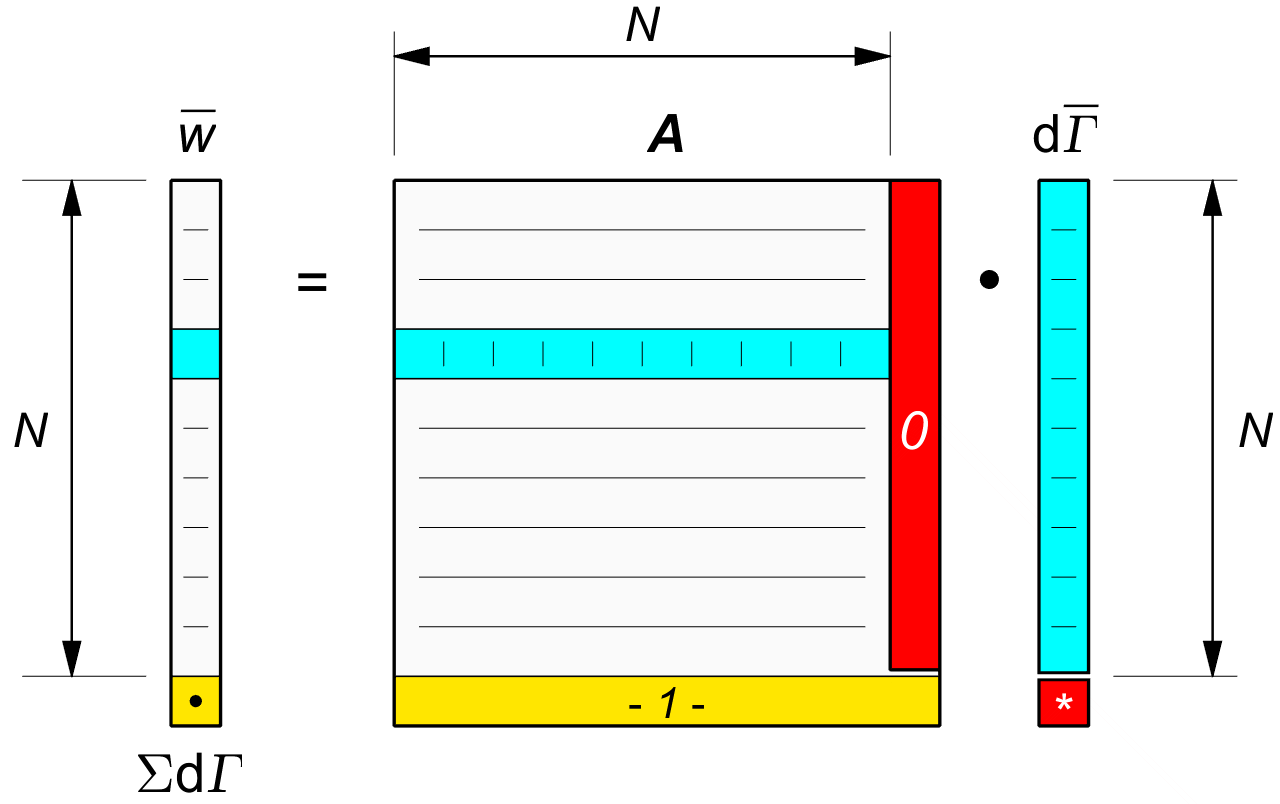
Figure 24.4 : The transfer matrix A in the propeller.
When the trailing vortices are known, the bound vortex is built up in the same way as for the wing in (22.12) :
| (24.10) |
The bound vortex outside a free blade tip is zero.
For a free tip, (24.10) starts with
Γ0 = 0
at xG = X.
We will discuss the ducted propeller later.
The first interpolated value is Γ1 = dΓ0 . The cumulative sum continues to k = N, where the root vortex (24.11) brings Γ back to ΓN+1 = 0, at xG = 0.
We will not need the zeros of the bound vortex at the core and tip to find the overall thrust. We only need the interpolated values Γ1 . . ΓN .
We find the average value of Γ . X in the same way as the wing lift in (22.XXXXXXXXXX), by summing over the staircase graph of Γ versus x :
TODO Fix the Gamma . X and the thrust.
| (24.11) |