TIP LOSS
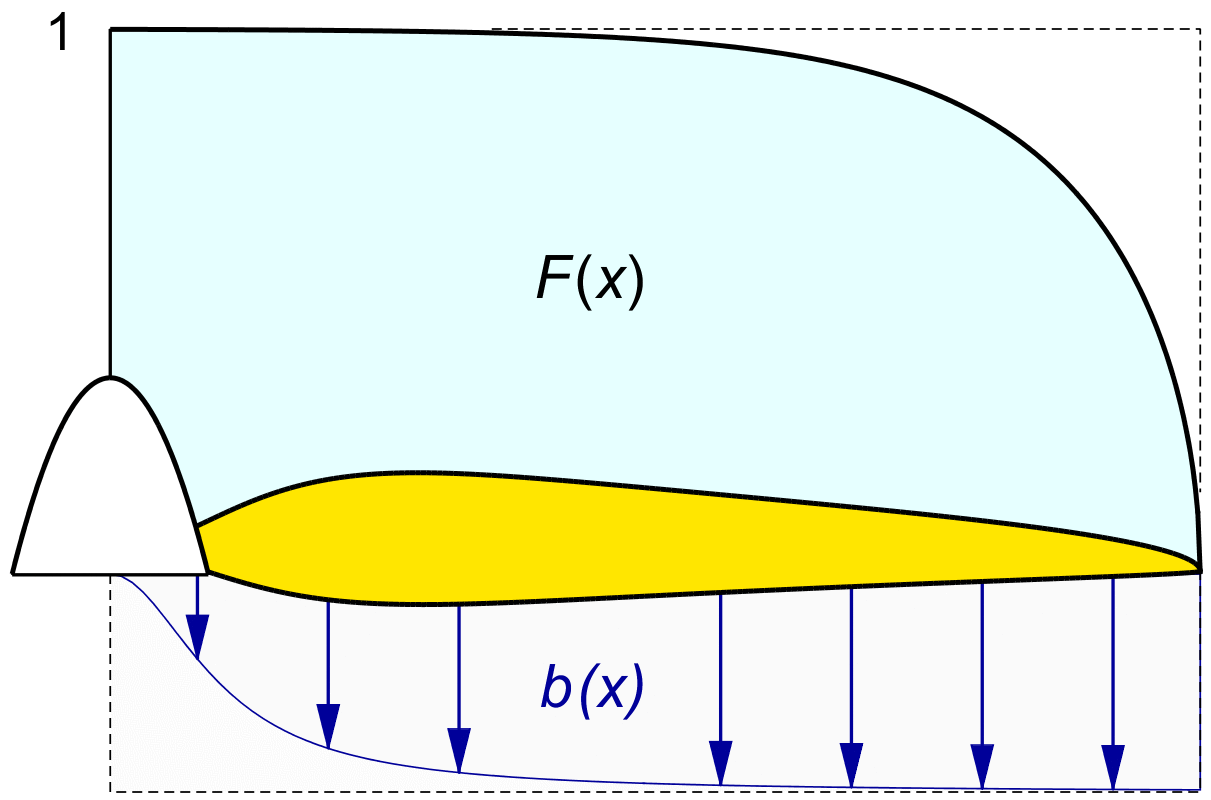
In the same 1919 article where Betz introduced his derivation of the thrust distribution for minimal rotational loss, Prandtl added an approximate tip loss model. This model has stood the test of time remarkably well. Somewhat surprisingly, it does not use the concept of blade lift or a tip vortex at all. Instead, it is based on the flow conditions around Betz's optimal spiral wake.
Figure 18.1 : Typical Prandtl mass flow reduction F(x).
Figure 12.4 showed Betz's Archimedes screw wake from figure 12.2, slowly translating and rotating. The spiral sheets are in actual fact drifting backward with the induced flow. It was Prandtl's idea to invert cause and effect here. Since no air passes through the sheet surfaces, we are allowed to imagine that they are smooth, hard surfaces, themselves displacing the air to the rear instead of the other way around. In potential theory, if two flows meet the same boundary conditions, they are identical. If we can find a solution for this new flow, it must be the flow we are looking for.
There is also no sliding friction on the surfaces, so they can only push on the air at right angles to their surface. This still does not make the problem trivial, for the Archimedes screw has a complex shape.
At the center, the sheets are highly curved; but at the outer edges, they are almost flat. The left hand side of figure 19.1 replaces the Archimedes screw by a stack of flat disks, with the same spacing as the tip spirals in figure 12.3.
The disks move to the rear with the induction velocity v', and they take the air with them, except around the edges. Some air is pushed to the side and circles back, creating a wavy outline to what was once a smooth flow tube.
Prandtl further simplified this model by making it 2D. He made the edges into straight lines, like the straight fins of a heat sink. He then inverted cause and effect again, by considering the case where the fins are stationary, and the air flows by them at the velocity v'. The relative motion is still the same, and the flow pattern does not change.
The right hand side of the figure shows this simplified model. The only size parameter it has is the spacing s between the fins.
From potential theory, Prandtl was able to derive an equation for the impulsive force distribution on a fin when this system is instantaneously set in motion. A force impulse creating a step in the velocity is the equivalent of a force of some duration creating an acceleration for some time. In both cases, the ratio is a mass.
The outcome is an estimate for the “exact” mass coefficient K (x) of (17.2), at least for the tip regions of this simple model.
TODO LATER Make a better story on the potential theory, maybe from the current previous chapter, or an older/later version of the printed book.
TODO LATER Emphasize once more the difference between induction and mass flow. And it's much better than a vortex model. Betz's helical wake sheet is much more similar to the constant downflow wing model, than the isolated tip vo3tex is. Refer to section **** on vortex methods.
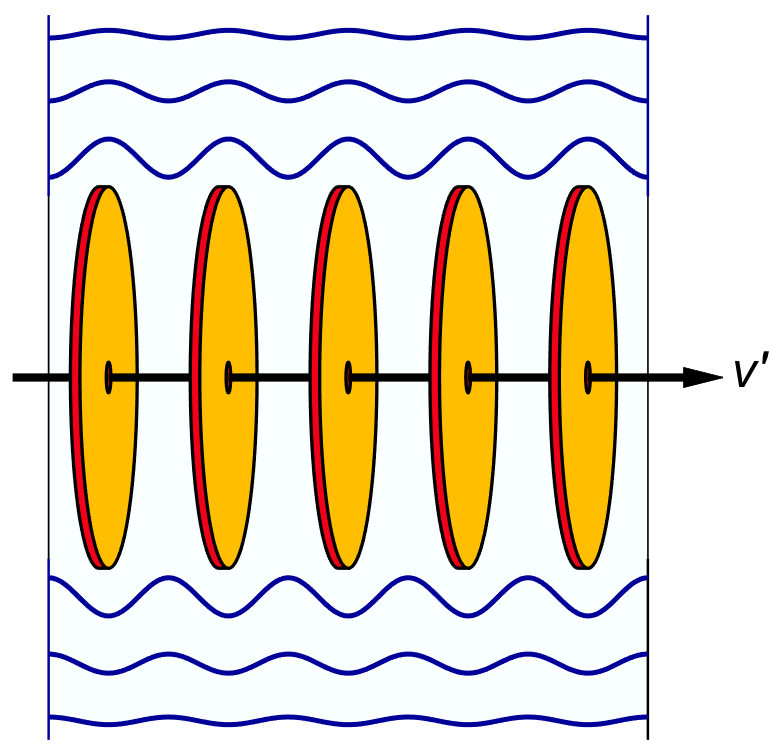
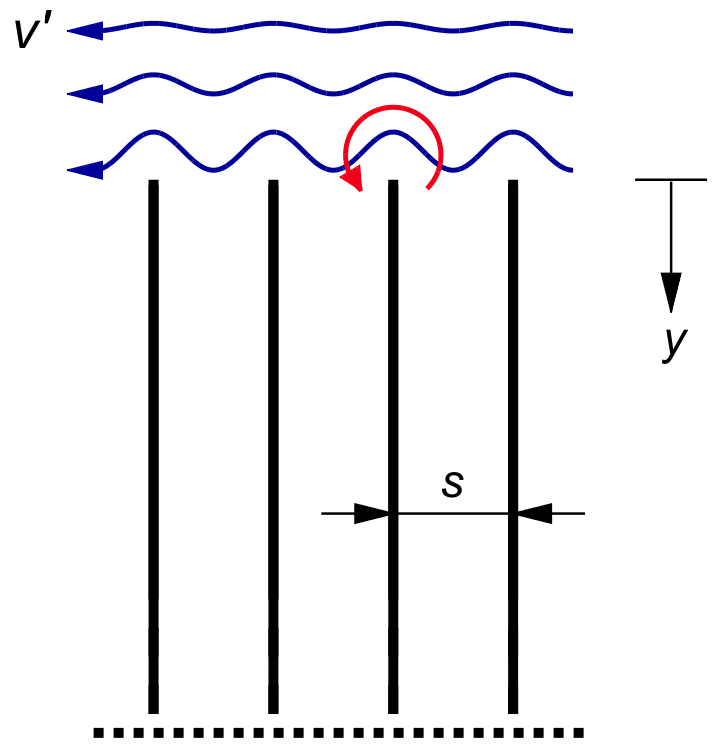
Figure 19.2 : Spiral sheet simplified to infinite heats sink fins.
Prandtl's approximate solution for K (x) is traditionally denoted by K (x).
The Notes section discusses the shape, and Prandtl's derivation of it in some more detail.
Figure 19.1 gives y as the distance from the tip, and s as the spacing between the tips. With this definition, PRANDTL's equation reads :
| (19.1) |
As expected, F (y) is zero at the outer edges of the fins. All of the air bypasses the fins there. Evaluating the equation at y = 0 in fact gives exp (0) = 1 and acos (1) = 0, so F (y) = 0.
Deep inside the fins, F (y becomes 1 for y → ∞. All of the air is trapped there. The equation gives exp (−∞) = 0 and acos (0) = ½π, so F (y = 1.
In between these extremes, Prandtl's tip shape is remarkably similar to a quarter circle with radius s. Figure 19.2 compares the two shapes. The figure confirms the strong family likeness between the elliptical mass coefficient of an optimal wing, and the optimal propeller.
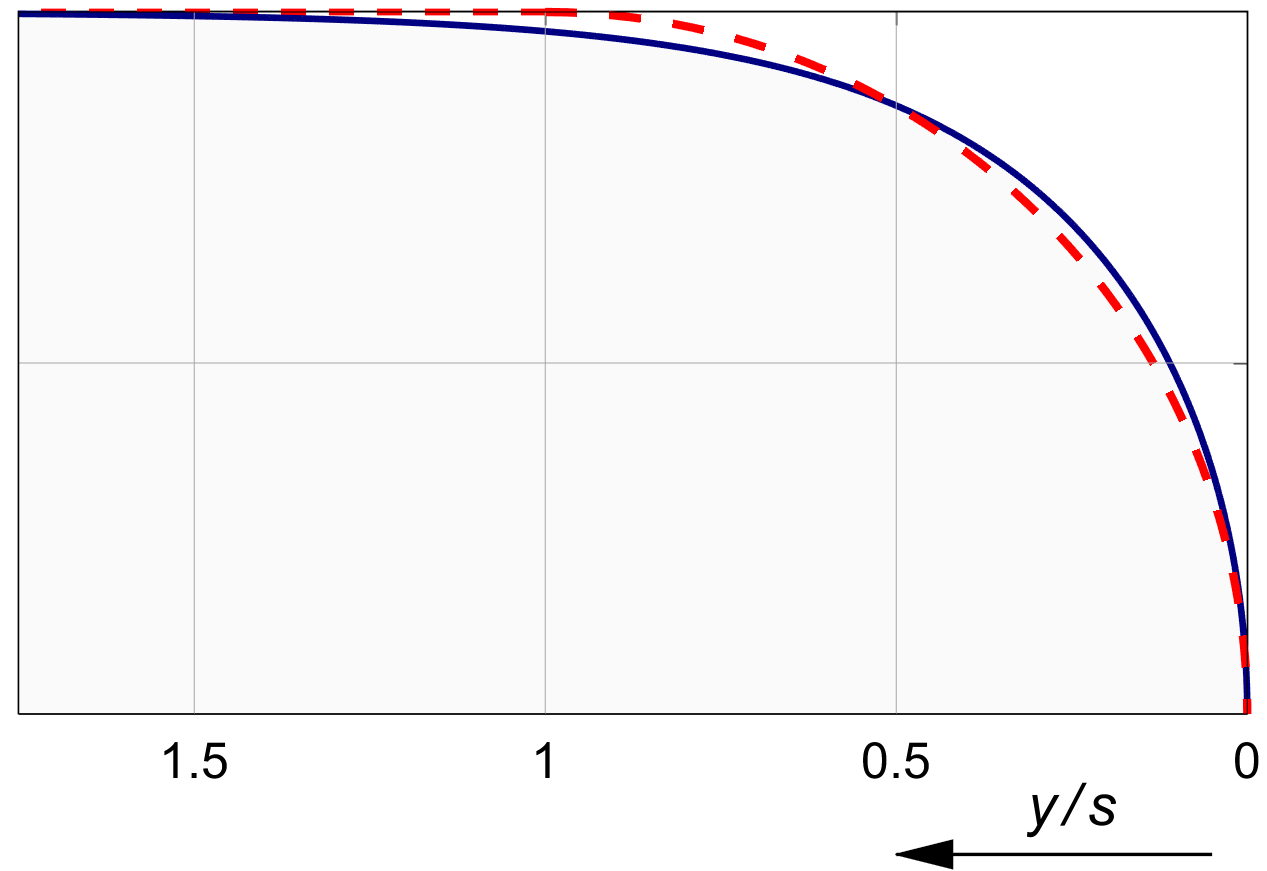
Figure 19.1 : Prandtl's tip shape scaled to a quarter circle.
We will fit Prandtl's tip model (19.1) to the non-dimensional propeller. The distance between the "heat sink fins" is given by the spacing between the spiral sheets. Prandtl applied his 2D model to the orthogonal distance between the sheet surfaces, because this is the direction in which the sheets displace the air, and it is the direction of the induction velocity v ′. We will briefly follow Prandtl's physically sound reasoning, before converting to the simpler axial distance, which not only gives simpler equations, but also happens to fit the exact vortex solution slightly better.
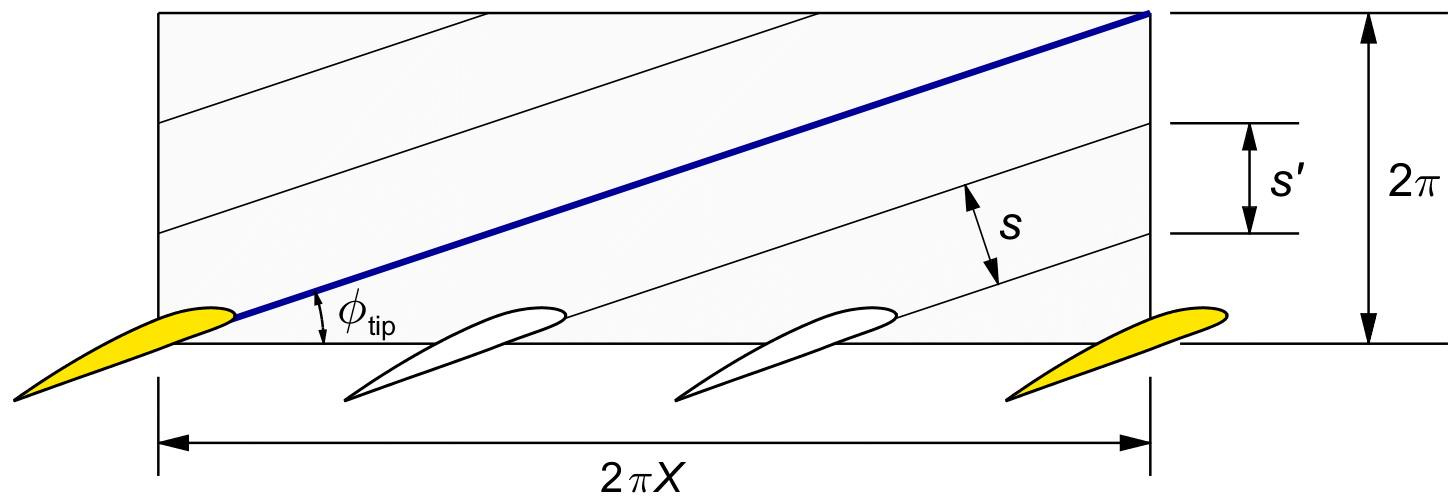
Figure 19.3 : The non-dimensional spacing between the tip spirals.
Figure 19.3 shows the "unrolled" outer surface of the original, smooth flow tube in non-dimensional units. All lengths are divided by the unit distance U of (2.9).
The radius of the propeller is X, and the circumference of the flow tube is 2 π X. By figure 2.4, this makes the non-dimensional tip pitch 2 π. In a propeller with B blades, the tip spirals are spaced in the axial direction by the non-dimensional distance s ′ :
| (19.2) |
From the figure, the orthogonal distance between the sheets is shorter than the axial one by a factor of cos φtip. With (2.5) for the cosine, we have :
| (19.3) |
Prandtl based his model on this orthogonal sheet spacing, but in fact his function fits the exact vortex solution better if we use the axial spacing s' instead.
As a side benefit, this simplifies the equations. To distinguish between the two versions of s, we will use the notation F ′(x) ( with a prime ) for the version of F which uses the axial spacing of (19.2).
Note ( X − x ) is the distance from the tip at X, measured on the scale of x ≡ Ω r / V.
| (19.4) |
This, then is our simplified and improved version of Prandtl's approximation for the mass flow factor K (x).
Figure 19.4 gave the factor F ′(x) scaled to our standard example of X = 5, for two blades.
Figure 19.6 shows what happens when we vary these parameters. On a horizontal scale of B . X, the tip length is fixed at 2 π, and the blade length shows up as B . X. This keeps the relative tip depth in the proper proportion. The tip has always the same shape, but with increasing B . X it covers a shorter fraction of the blade.
Propellers with the same value of B . X have the same tip length ratio, regardless whether this comes from B or from X. A propeller of X = 10 and B = 2 has the same tip ratio as a propeller of X = 5 and B = 4.
Propellers with large values of B . X have relatively small tip ratios and hence lower tip loss.
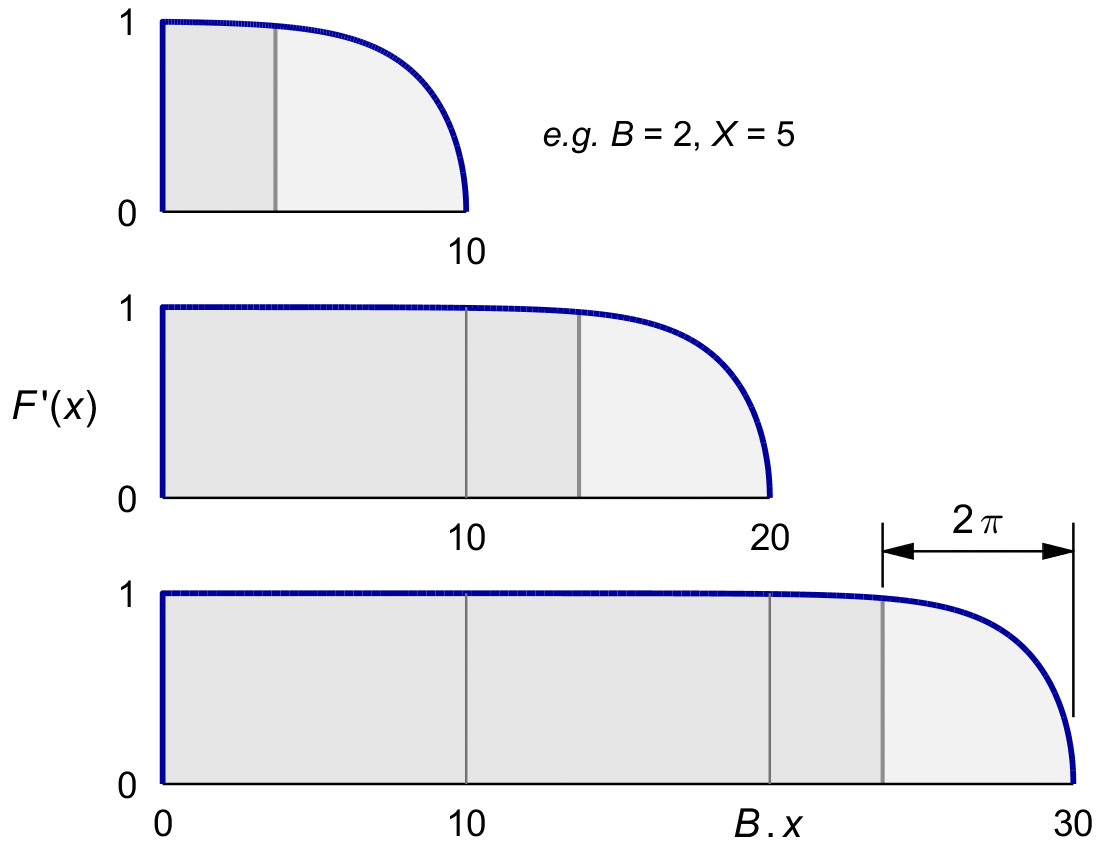
Figure 19.6 : Prandtl's tip length versus B . X.
Using (19.2), we can redraw figure 19.2 on the non-dimensional x scale. The tip shape will now start at a distance of ( X - x ) = 2π/B from the tip.
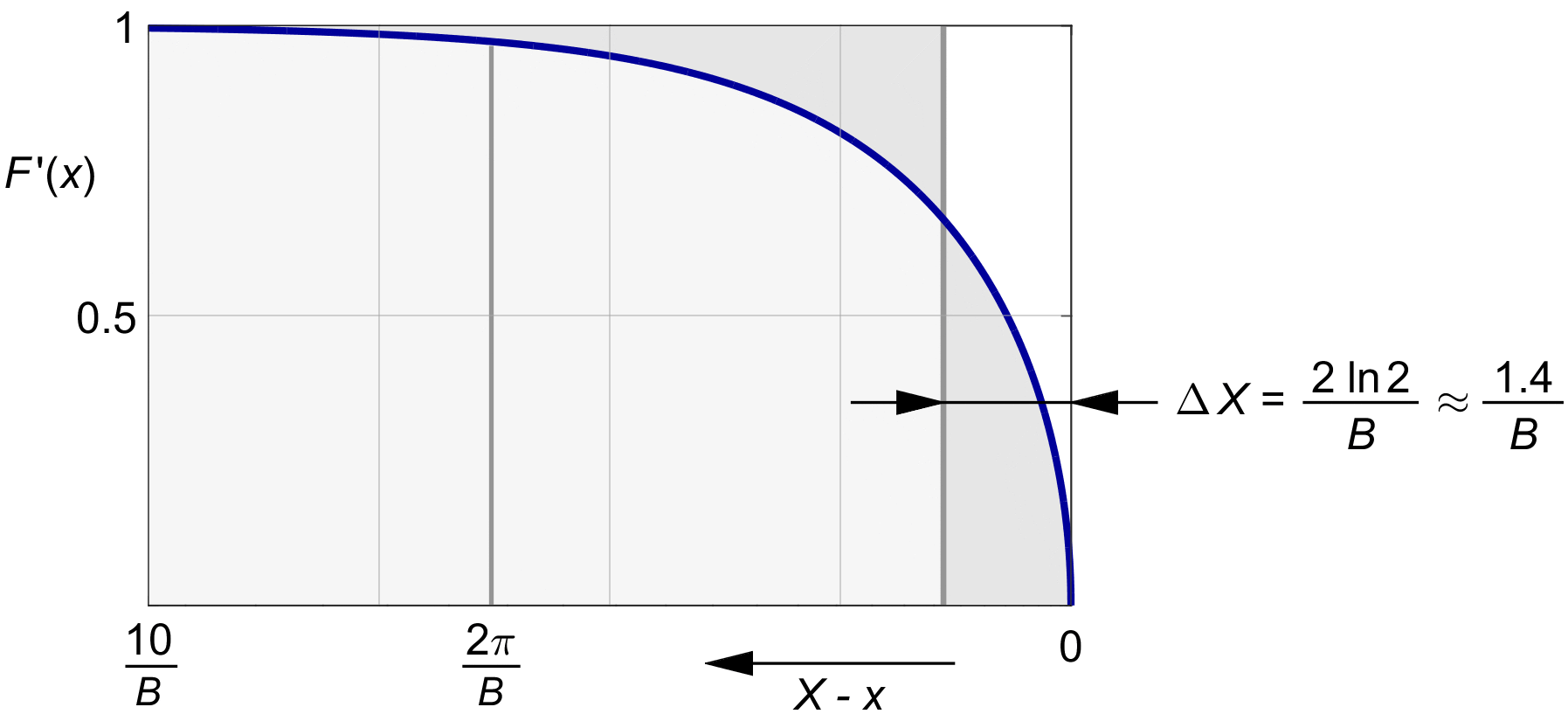
Figure 19.4 : Equivalent cropped tip for X = 5, B = 2.
Figure 19.4 shows the result. The plot runs from ( X - x ) = 0 at the right to 10 / B on the left.
Taken from left to right, this equals from x = 0 at the root to X = 5 at the tip for pur running example of a two bladed propeller with a tip speed ratio of 5.
This makes it a plot of F' (x) for our standard running example of B = 2, X = 5. The tip shape starts from (&iarsp;X−x ) = 2 π& / 2, i.e. from r/R = ( 1 - π ) / X, or in other words from r ≅ 0.4 R. The "tip" therefore extends over more than half of the outer blade. It covers most of the disk area.
The figure also shows a simple approximation for the net area loss. Prandtl noted that the blade tip can be replaced by a blade of full width, clipped off straight at a reduced diameter. The figure shows the cropping length ΔX which gives the same equivalent area loss as Prandtl's tip shape. It is the following fraction of (19.2) :
| (19.5) |
The function value of F(x) at the cropping radius is 2/3.
The ellipse approximation gives almost the same area reduction, since the area loss of a quarter circle shape equals 1 − ¼π ≅ 0.215, which is almost identical to 0.22.
With s ′ ≅ 2 π&thinp;/ B, the cropping distance on the x scale becomes :
| (19.6) |
The "effective" radius of the propeller will be :
| (19.7) |
The propeller is equivalent to a square tipped propeller inside a duct of this reduced radius. Figure 19.5 shows the relative size of the reduction for our standard example of a two-bladed propeller of tip speed ratio 5.
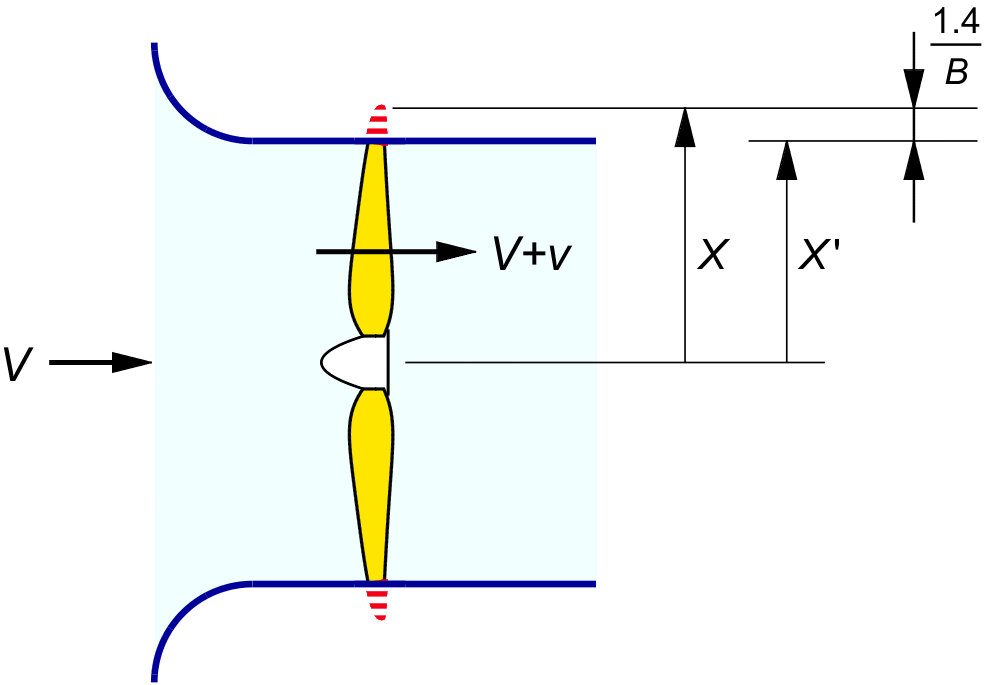
Figure 19.3 : Equivalent duct radius for X = 5, B = 2.
With (19.7) for the radius, the effective disk area reduces to :
π 〖X^' 〗^2 = π X^2 .〖 ( 1- 2 ln 2 /(B.X) )〗^2 = π X^2 .( 1- 4 ln 2 /(B.X) + ( ( 2 ln 2 )/(B.X))^2 ) (19.8)
If B . X ≫ 1, the quadratic term is small. Prandtl therefore dropped it, keeping only the linear term. We will call his approximation of the overall tip mass reduction factor κF' :
κ_ F ' ≅ 1 - 2.77/(B .X) (19.9)
This κF' estimates the integral of the local mass factor K (x) defined in (17.2). It is not the same as the integral κ G in (17.9), because that contains the cos2ϕ term as well.