VISCOUS LOSS
Viscous loss is the "leadscrew" part of the power loss. The leadscrew acts in a flow accelerated by the propeller's own thrust, but the screw itself does not know it. It just threads itself forward relative to the surrounding air, even if that air is slipping backward.
At the design stage, the sliding friction force is proportional to the blade lift force. The ratio is called the friction coefficient. It is usually indicated by μ ( the Greek letter mu ). The ratio is the tangent of the angle at which a friction block would begin to slide down a slope.
The aerodynamic equivalent is the inverse of the glide ratio Cl / Cd of the blade sections. At the design stage, we will use the prop blades at their best Cl / Cd, so we can consider the "friction angle" of the blade sections as a constant. In off-design calculations this will no longer hold. In that case the behavior is closer to a constant Cd at varying Cl. There are also secondary effects of the Reynolds and Mach numbers. These are best solved by numerical methods.
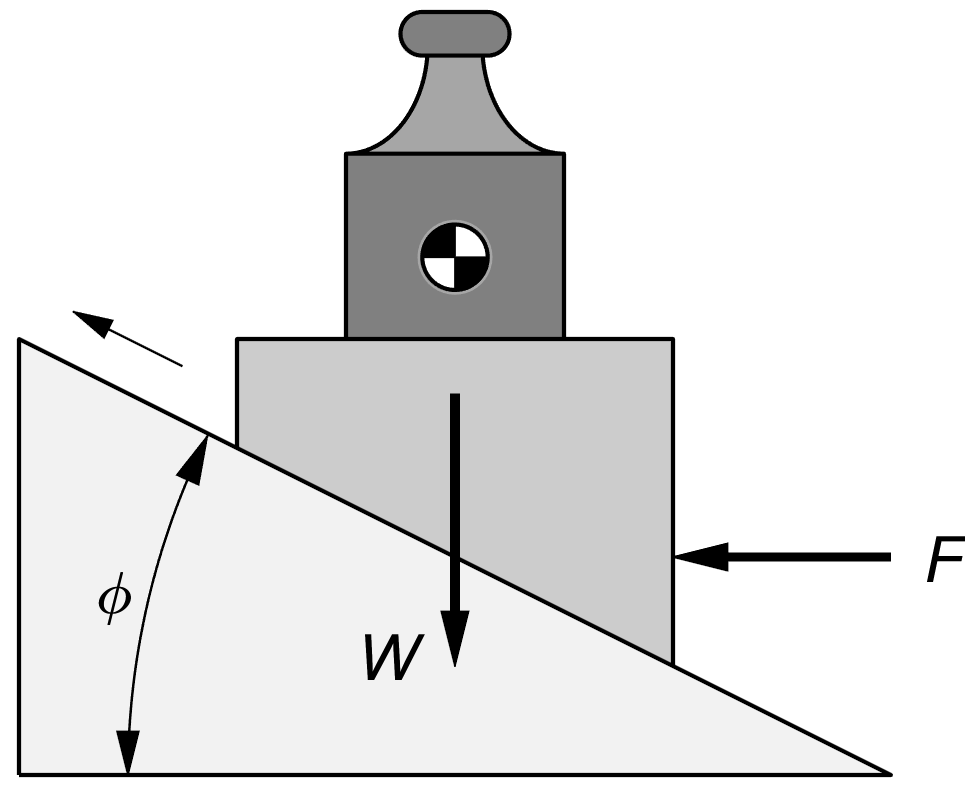
Figure 14.1 : Horizontal force pushing a block up a slope.
Figure 14.1 shows a horizontal force pushing a block up a slope. On a slope of 1:10, the horizontal force F travels ten times the distance of the vertical ( weight ) force W. From the power balance ( with power equals force times displacement ), the force F will be ten times lower than the force W, in the ideal case with no friction.
For small angles, the force normal to the surface approximately equals the block weight W, and the friction force almost directly opposes the horizontal driving force F.
Force F will have to move the friction force over 10 times the distance of the vertical displacement. This costs 10 times more friction power than if F could have lifted the force W directly. The frictional loss relative to weight is ( approximately ) inversely proportional to the slope. A more precise analysis in the next section will confirm this.
Most mechanical leadscrews more or less have a single slope angle, for a single outside ( almost outside ) diameter. Their thread does not cut very deep. In propellers, the "thread" goes right to the core. This causes considerable pitch angle variation with radius. Therefore we will subdivide the prop disk radially into rings, and analyze each radius separately.
The friction force is proportional to the load. Unlike the momentum loss, the frictional efficiency does not depend on the loading. It only depends on the average radius where the load applies, and on the local friction coefficient.
We now look at the lift and drag forces on a blade element at radius r. Figure 14.2 shows the force diagram. We assume light loading for the moment, so the actual pitch angle φ′ is approximately the same as the nominal pitch angle φ = atan ( V / Ω r ) for the free stream conditions.
In more precise calculations, we can substitute the actual φ′ for φ.
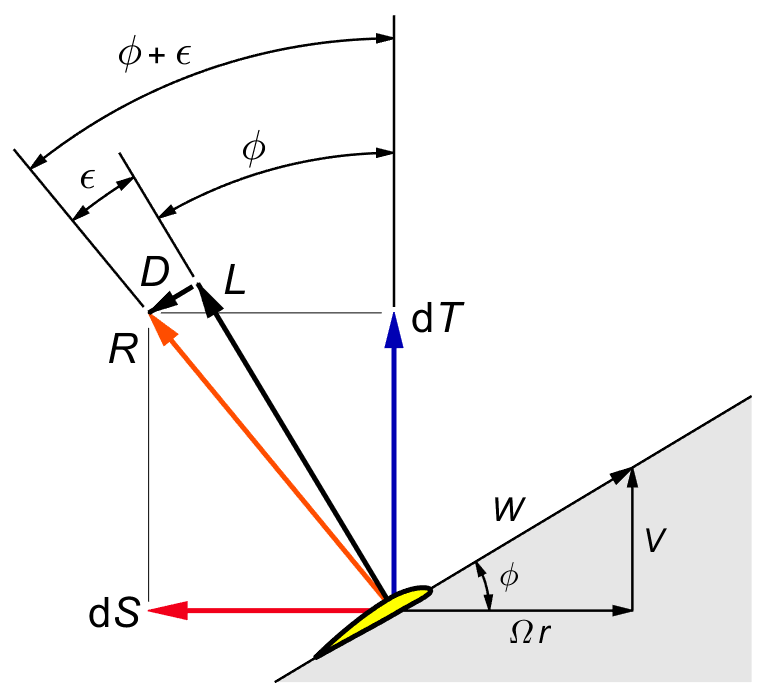
Figure 14.2 : Thrust and torque on a blade element.
The forward velocity of the airplane is V, and the propeller rate of rotation is Ω ( in rad/s ). The local lift L is orthogonal to the local velocity W. The drag D is that part of the aerodynamic force which is orthogonal to L. The resultant of L and D is called R. The drag D is an order of magnitude smaller than L. We can interpret R as a slightly rotated version of L.
The viscous backward angle of tilt ε follows from the ratio between D and L. In wing sections this is called the "glide angle", which is the inverse of the "glide ratio" L / D:
| (14.1) |
We can separate R into an alternative pair of orthogonal components : the thrust force dT and the tangential force dS, the "d" prefix meaning "for a ring" as in (6.1). From figure 14.2 we have :
| (14.2) |
| (14.3) |
With (14.2), the net power exerted by the ring on the airplane is :
| (14.4) |
From figure 14.2, for a blade element dr at radius r the torque Q is :
| (14.5) |
The power needed to turn the propeller is
the shaft torque Q multiplied by the rotation rate
Ω in rad/s.
With (14.3) for S, the shaft power is :
| (14.6) |
The viscous efficiency of the blade element is net output power over shaft input power :
| (14.7) |
With tan φ = V / Ω r, we have :
| (14.8) |
This formula goes back to Froude . It is the standard efficiency equation for mechanical leadscrews with friction angle ε. For zero friction, i.e. for ε = 0, the propeller is like an ideal leadscrew. It will convert shaft torque into forward thrust with perfect efficiency. For pitch angles φ of ( 90°- ε ) and higher, the efficiency becomes zero. The leadscrew seizes, or "locks up".
In propellers, this condition occurs close to the hub. We will ignore it, and analyze the efficiency only for moderate angles of φ and small angles of ε.
We can find the local power loss ratio from the viscous efficiency. Equating (14.8) to the efficiency definition of (3.8) we have :
| (14.9) |
Some reworking gives :
| (14.10) |
We will call the viscous power ratio μ ( Greek letter mu ), deliberately giving it the feel of a friction coefficient. The analogy is not complete, but we will see later that μ is close to a projected version of the surface friction coefficient ε :
| (14.11) |
Figure 14.3 shows μ as a function of φ. Textbooks on mechanical drive components give a full analysis of (14.8) which we will not repeat here. In the region beyond φ = 90° - ε the leadscrew is "self locking". The figure shows this region as a shaded vertical bar, scaled here for ε = 0.02.
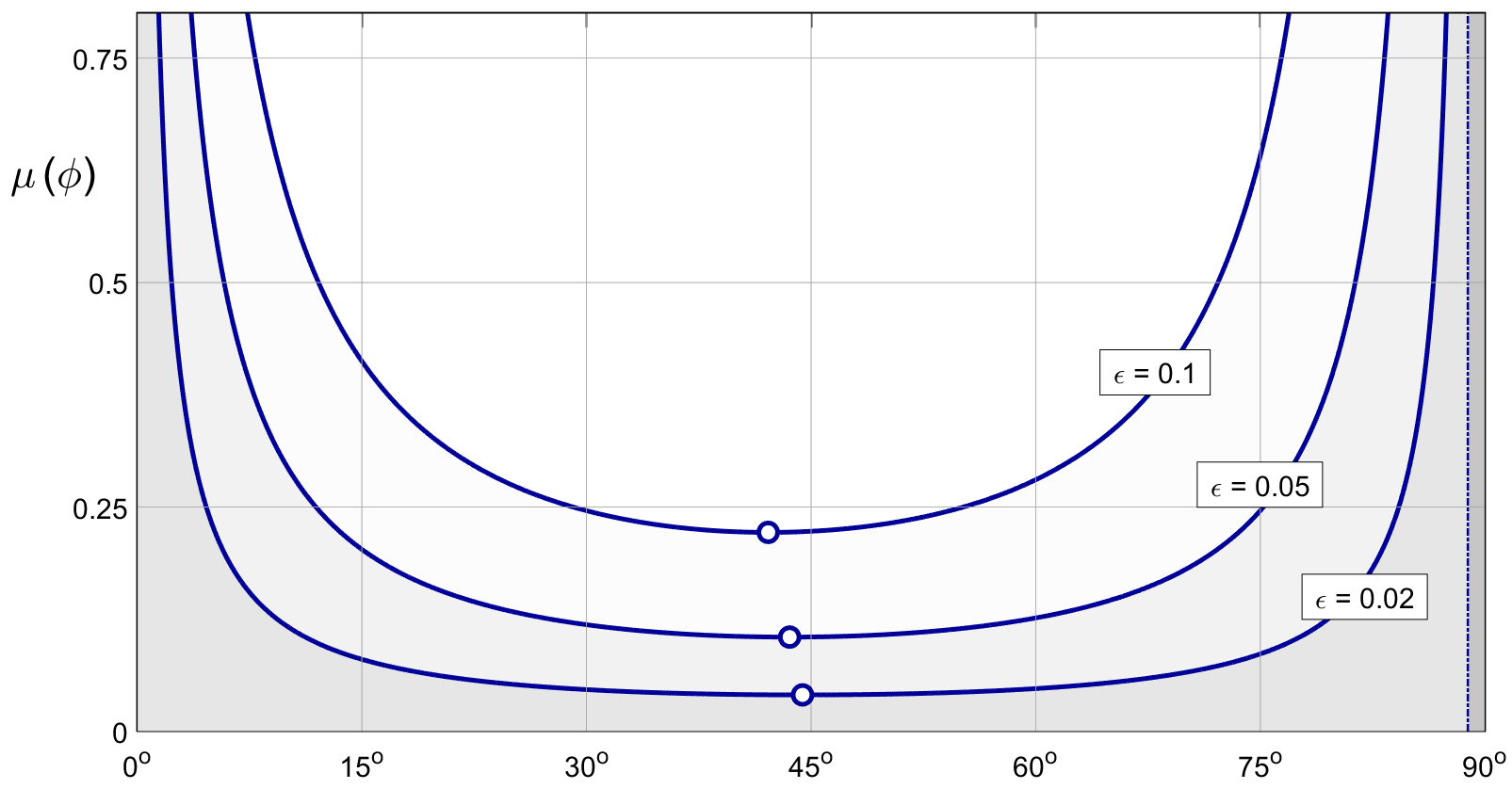
Figure 14.3 : The local leadscrew loss ratio μ(φ).
The viscous efficiency is optimal for a pitch angle of ( 45° - ½ ε ). It is left-right symmetrical around this vertical line. At the optimum point, the loss ratio is nearly 2 ε. If ϵ is small, the optimum angle is close to 45°.
Most of the thrust in a propeller is delivered on the outboard part of the blade, at relatively flat pitch angles. Low pitch angles are favorable with respect to rotational momentum loss, but they are the least favorable condition with respect to profile drag. From a viscous point of view, all thrust should be concentrated in a short paddle near the radius where the pitch angle is 45°. Simple wind turbines with sheet metal blades of poor lift‑to‑drag ratio ε = Cd / Cl in fact use exactly this arrangement.
Expression (14.10) for the frictional loss ratio can be greatly simplified with almost no loss of precision, by noting that the numerator is a finite difference between two tangents. Since the friction angle ε is usually small, we can approximate this difference by ε times the derivative of the tangent. That derivative is 1/cos2 φ :
| (14.12) |
This changes (14.10) into :
| (14.13) |
Using tan φ = 1/x from (2.4), we have a simple yet almost exact expression for μ, which is easiest remembered in mixed coordinates φ and x :
| (14.14) |
Eliminating φ completely by (2.8), this is the same as :
| (14.15) |
Figure 14.4 shows the exact value (14.10) of μ (x) as a solid dark blue line. It is the same as figure 14.3, only skewed to the left because it is against x instead of against φ. The figure also shows approximation (14.14) as a dashed line.
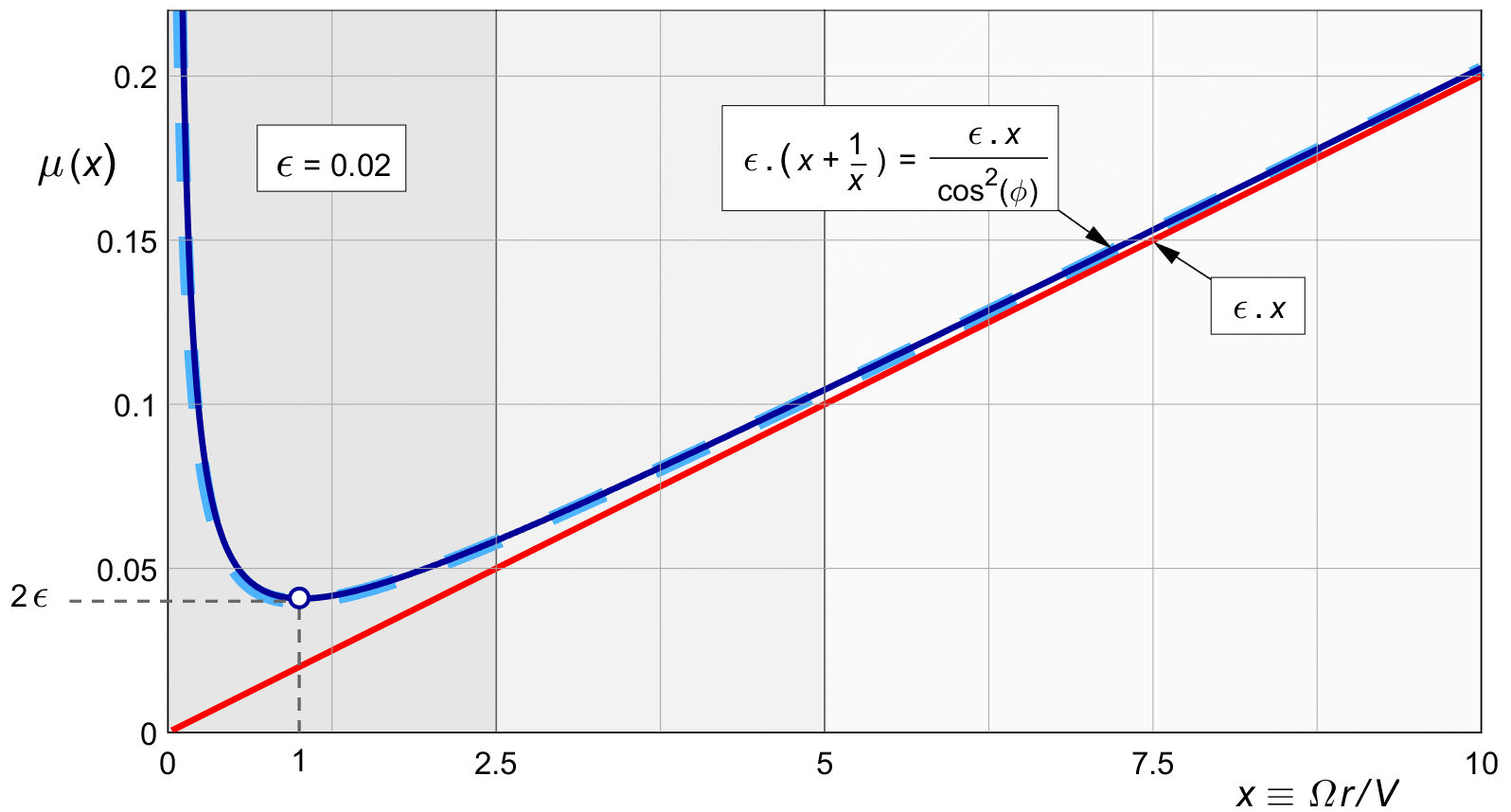
Figure 14.4 : The local leadscrew loss ratio μ(x).
For all but the smallest values of x, i.e. for all pitch angles except φ ≅ 90°, the approximation is nearly perfect. The factor μ reaches a minimum of 2 ε near x = 1, the point where φ equals 45°.
Some of the literature, like Glauert, will set cos2 φ ≈ 1 :
| (14.16) |
Figure 14.4 shows this further simplification as a straight line. It comes closest to an interpretation of μ as the "geared" friction coefficient ε.
In the vector diagram of figure 14.2, for small angles φ a small driving force S is equivalent to a large thrust force T by a factor of x = 1 / tanφ. In the same way, a small friction force becomes a large drag force.
The nearly exact μ (x ) of (14.14) can also be loosely derived directly from the force diagram. We split the viscous drag vector D into two orthogonal components, which we shall call ΔdT and ΔdS.
Via the steps of ΔdT ≅ D . sin φ, D ≅ ε . L, and L ≅ dT/cos φ, we have :
| (14.17) |
Similarly, via ΔdS ≅ D . cos φ, we have :
| (14.18) |
With some hand waving, we can say that if we multiply these two orthogonal drag forces each by the local velocity in their own direction, we will obtain the two terms contributing to the local power loss due to drag.
The drag component ΔdT directly opposes the flying velocity V, and the drag component ΔdS directly opposes the circumferential blade element velocity Ω r. The total local drag power loss is :
| (14.19) |
Substituting (14.17) and (14.18) and dividing by dT.V, the local loss ratio is :
| (14.20) |
With (2.2) we have tan ϕ = 1/x and Ω r/ V = x , and so (with (3.9) ) :
| (14.21) |
This recovers (14.14). The derivation shows that the linearization (14.16) amounts to looking only at the effect of the viscous drag on the torque, and neglecting its effect on the thrust.
The power calculation of (14.19) misses a subtle point. The viscous drag component ΔdT of (14.17) detracts from the propeller's thrust, and to maintain the original thrust we need to increase the momentum thrust by that small amount. This will cause a small additional momentum loss. Following the rest of the literature, we will neglect this extra loss.