ROTATION
We will now find the thrust distribution which minimizes the rotational loss for a given overall thrust, by the method of "constant marginal loss".
The rotational momentum loss ratio (9.3) and the efficiency (9.4) vary along the blade, since they depend on the local pitch angle φ. Intuitively, we can move thrust from a radius with low efficiency to a radius with high efficiency, making the whole propeller more efficient. We should keep doing this until all locations have the same efficiency, so no further gains are possible.
By inspection of (9.3) and (9.7), for light loading we can make the efficiency the same everywhere by scheduling b (x) with cos2 φ. We will find below that this is in fact the optimal solution.
But having the same efficiency everywhere is not formal proof of optimality. The formal proof requires that we make the marginal efficiency the same everywhere. This is not the same thing.
A small change in the ring thrust dT, or better a small change in the net ring power dT . V, will cause a small change in the ring power loss. The ratio between this extra power loss and the extra net power is called the marginal loss.
As long as the derivative of dPm with respect to dT is not the same everywhere, we can gain efficiency by taking increments of thrust away from locations with high marginal loss, and moving thrust to locations with low marginal loss. We will stop moving thrust only when the derivative has reached the same value everywhere, i.e. when the marginal loss has the same value everywhere. We will call this constant marginal loss ratio C :
| (10.1) |
The inner "d" 's indicate ring values, the outer "d" 's are the symbols for the derivative.
Since we are not varying flight conditions like ρ or V, or any propeller geometrical parameters like R or X, then by (3.9) we can write the same equation in non-dimensional form :
| (10.2) |
The ring thrust dT ′ is the variable driving the change. We could express dPm′ as a function of dT ′, and take the derivative of dPm ′ with respect to dT ′ directly.
But it is easier to use the local value of the induction ratio b (x) as the variable driving both dT ′ and dPm′.
The marginal loss then becomes :
| (10.3) |
We will look at the light loading case first. This will take the factor of ( 1 + ½ b ) out of the d Pm′ of (9.4).
Taking the derivative with respect to b yields :
| (10.4) |
Taking the derivative of the dT ′ of (7.14) yields :
| (10.5) |
The results are so simple because the derivative of ½ b 2 is b, and the derivative of b is 1.
Subsitituting (10.4) and (10.5) into (10.3) yields :
| (10.6) |
For optimality, the marginal loss C must be a constant. As a result the axial induction ratio b will have to vary along the blade :
| (10.7) |
The rotationally optimal induction (10.7) contains a factor of cos 2 φ. We will meet this factor in numerous places in the theory of propellers. We will give it a name, although we will also often write it out in full :
| (10.8) |
By (10.7), g ( x ) is a reduction factor on the local induction, relative to an ideal actuator disk of uniform induction C. The factor is always smaller than 1, since the cosine is always smaller than 1.
With (2.7) we can also express cos 2φ directly in x :
| (10.9) |
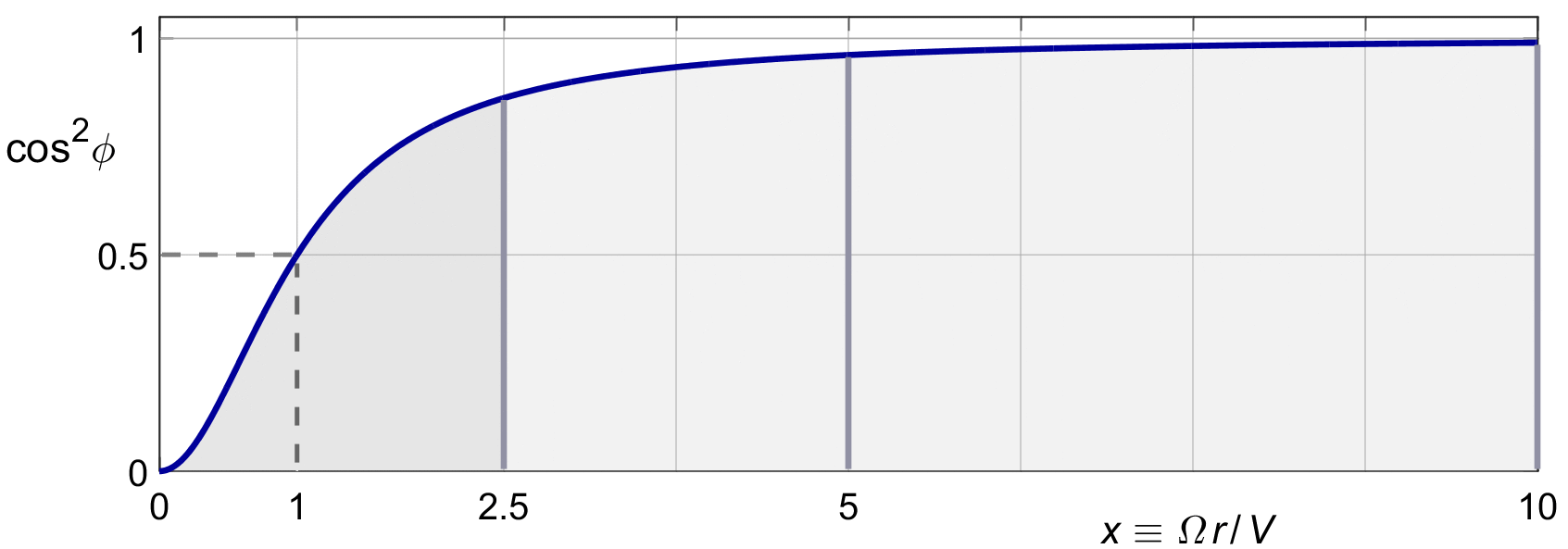
For x = 1, we have g ( x ) = ½. This fits with the cos 2φ formulation, since the local pitch angle at x = 1 is φ = 45°, and cos (45°) = 1/√2. For large x, the fraction goes to 1 by a difference of 1 / x 2.
Figure 10.1 shows the shape of cos 2 φ versus x. On a finite propeller blade, x will vary from x = 0 at the root to x = X at the tip.
Figure 10.1 : The optimal induction factor cos2 φ.
Having found the marginal loss C for the lightly loaded propeller, we are also interested in the actual overall loss ratio. Substituting the rotationally optimal distribution of (10.7) into the local loss ratio (9.6), the cos 2 φ terms cancel, to yield :
| (10.10) |
This actual local loss ratio is exactly half the marginal loss ratio C of (10.2). This is not a coincidence. The momentum loss of (9.4), for light loading where ( 1 + ½ b ) = 1, is just a quadratic in b, and we know that the local slope of a quadratic ( in this case, with the thrust b ) is exactly twice its local value.
Since the local momentum loss ratio is the same for every ring, the overall loss ratio will be the same :
| (10.11) |
With (10.6) in (9.7), the overall momentum efficiency becomes :
| (10.12) |
We now have an expression for the optimal momentum efficiency of the propeller which looks a lot like the efficiency (4.18) of a uniform actuator disk which had a constant induction of b ( x ) = C.
It would look for a moment as if the rotation did not harm the efficiency of the propeler at all. But that is a bit misleading. For by (10.5), for the same efficiency ( i.e. for the same overall loss ratio ½ C ), the thrust of this propeller will be less than that of the actuator disk.
We will briefly look at the case of heavy loading. Picking up the derivatives (10.4) and (10.5), using (7.13) and (7.17) for "heavy" loading, and omitting the terms of 2x.dx / X 2 which wil drop out later anyway, we note :
| (10.13) |
| (10.14) |
The ratio between the two is not the easy b of (10.6), but it is close.
However, in (9.4) there is also an additional term 1 / cos2 φ. Looking at figure 8.2 and equation (8.6), the local pitch angle φ will also vary with b. So we also need to take the derivative of 1/ cos2 φ with respect to b, and apply the chain rule in (10.4).
Although this can all be done, and approximations are available, the result will destroy the simplicity of the optimal induction (10.7) and make all subsequent equations opaque, without adding significant accuracy or optimality to the results.
This is the reason why the literature on classical propeller theory invariably applies the "light loading" assumption in all optimization problems, and so will we.