AXIAL MOMENTUM
We will briefly touch on the case of "heavy" loading. We can solve (5.9) for b by writing it as a quadratic :
| (6.1) |
Solving the quadratic gives one positive solution for b :
| (6.2) |
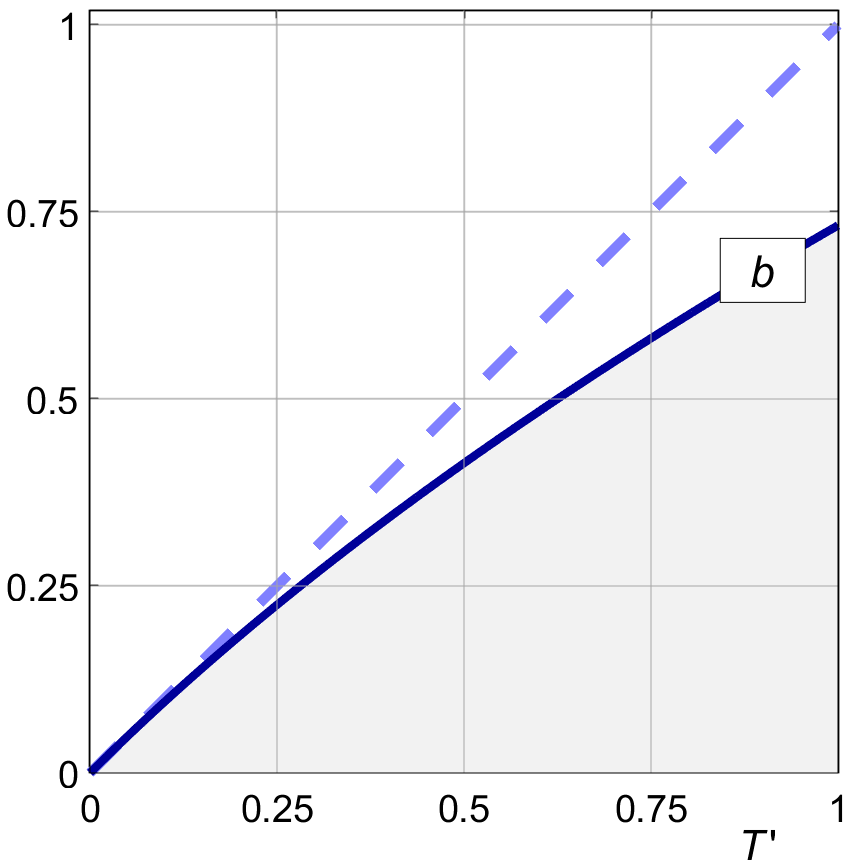
Figure 6.1 shows this relation. For small b, the approximation √ ( 1 + ε ) ≅ 1 + ½ ε recovers b ≅ T ′.
Figure 6.1 : Axial induction ratio b versus T ′.
For a given induction ratio and efficiency, the contraction of the flow tube ahead draws more air through the prop disk, increasing the thrust at the same efficiency, which gives the propeller a slight advantage. This is, however only a slight mitigation of the fact that in principle, the momentum loss of the propeller is directly proportional to the far wake induction b.
Later chapters will show that strictly, we should carry the ( 1 + ½ b ) term right through all of our calculations, including the derivatives with respect to b in the rotational optimization. This is not hard to do, but the small increase in accuracy for heavy loading does not outweigh the added complexity of the equations obscuring our intuitive understanding.
We will stay with the light loading assumption, mainly because it keeps the central arguments easier to follow.